

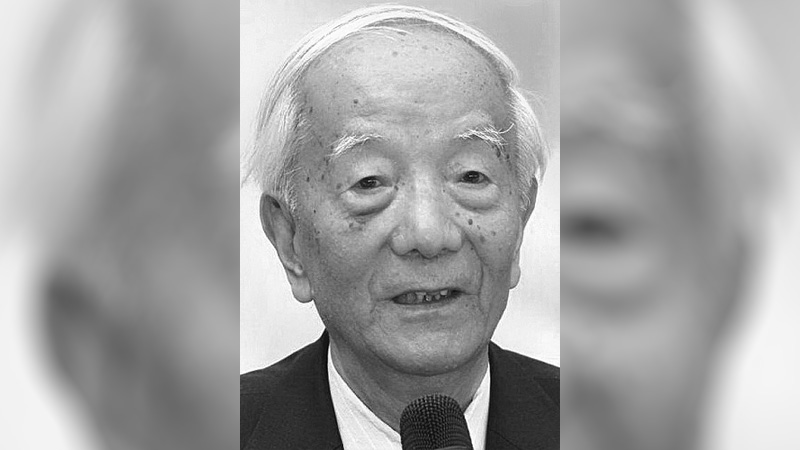
Wang Xiji, one of the pioneers of China's space industry and chief designer of the nation's first recoverable reconnaissance satellite, died in Beijing on Wednesday at the age of 105.
Born in Kunming, Yunnan province, in July 1921, Wang was the fourth child in a family whose father was a successful businessman. Driven by an aspiration to contribute to national rejuvenation, he was admitted to the mechanical engineering department of National Southwestern Associated University in 1938.
After graduating in the autumn of 1942, Wang worked successively at three local plants in Yunnan.
He nevertheless remained determined to put his knowledge to use for the country.
In 1948, he went to the United States to pursue advanced studies at Virginia Polytechnic Institute, majoring in power and fuel engineering. He earned a master's degree one year later. After learning from news reports about the founding of the People's Republic of China, he decided not to pursue a doctoral degree and instead resolved to use his expertise to help build New China.
Wang returned to China in March 1950 alongside dozens of patriotic Chinese scholars. He taught at Dalian University of Technology and later at Shanghai Jiao Tong University.
In 1958, at the age of 37, Wang was transferred to the Shanghai Institute of Mechanical and Electrical Design — as it was known — now part of the China Academy of Space Technology, to lead the development of sounding rockets. This marked the beginning of his lifelong career in the space sector.
Facing an almost nonexistent technical foundation and limited industrial support, Wang and his team began developing scaled-down test rockets under extremely rudimentary conditions.
With only hand-operated calculating devices at their disposal, several people worked day and night for more than two months just to calculate a single trajectory. The stacks of paper they used for the calculations were higher than their desks. With no launch site available, they turned a rice field into one, using a winch to hoist the rocket onto the launch stand and a hand pump to pressurize and charge the rocket with propellant.
In February 1960, China's first liquid-fuel sounding rocket lifted off from a desolate beach on the outskirts of Shanghai, reaching an altitude of several kilometers. Wang later described the launch as the most important success of his career because it marked China's first tangible step toward space.
He went on to oversee the development of 12 of China's 18 early sounding rocket models. These rockets gradually reached altitudes of more than 100 km and carried out missions ranging from atmospheric detection and space-instrument verification to biological experiments involving small animals.
Drawing on experience with sounding rockets and ballistic missile technology, Wang formulated the overall design plan for China's first carrier rocket, the Long March 1. The rocket made its maiden flight on April 24, 1970, successfully placing China's first satellite, Dongfanghong 1, into orbit.
Wang later served as chief designer of China's first recoverable reconnaissance satellite. After numerous tests and calculations, the satellite was successfully launched and recovered in Guizhou province in November 1975, making China the third country in the world to acquire satellite-return technology.
He also led research and design work on several subsequent models of recoverable reconnaissance satellites.
In the 1980s, Wang was invited to participate in the development of China's manned spaceflight roadmap. Based on his analysis of economic feasibility and China's actual technological and financial capabilities, he was a prominent advocate of starting with non-reusable crewed spacecraft rather than pursuing the more costly space shuttle approach.
In 1993, he was elected an academician of the Chinese Academy of Sciences.
Through extensive practical exploration, Wang remained committed to a scientific, rigorous and pragmatic approach.
He once said, "When it comes to technical issues, we cannot simply follow the majority. Instead, we must respect objective laws and remain committed to seeking truth from facts. Sometimes, the minority who insist on their views are the ones who are right."
Wang remained active in the space community well into his later years.
At 80, he served as chief designer of the Double Star Program, a China-Europe joint initiative to explore Earth's magnetosphere. In his 90s, he advocated research into space-based solar power stations, and at 95, he led studies on the application of internet technologies to space programs.
The veteran engineer also pioneered concepts such as "space infrastructure" and wrote several professional books to pass on his engineering expertise to younger generations.
In recognition of his dedication and contributions, the government honored Wang as one of the key figures in China's ballistic missile, nuclear weapon and satellite programs and awarded him numerous honorary titles.
