

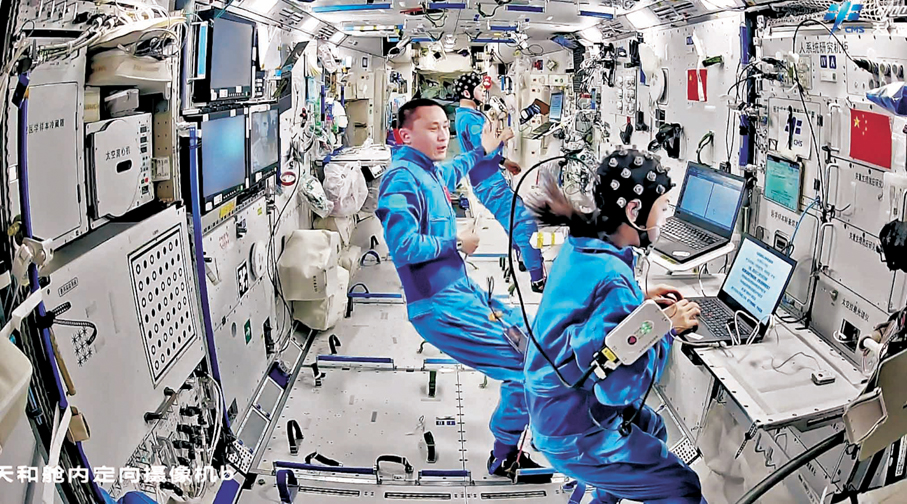
BEIJING – Lai Ka-ying, the first astronaut from the Hong Kong Special Administrative Region, and her two crewmates on the Shenzhou XXIII space mission have recently completed a study on gut microbiome changes as a result of long-duration spaceflight, as they reached their 60th day in orbit aboard China's space station.
During this period, Lai and her colleagues Zhu Yangzhu and Zhang Zhiyuan have also systematically carried out a range of tasks, including multiple scientific experiments, maintenance of the space station complex platform, and in-orbit health management, according to the China Manned Space Agency (CMSA).
Using a space Raman spectrometer, the crew conducted research on microbiome and nutritional metabolism to analyze changes in intestinal flora and their effects on nutrient metabolism under extended spaceflight conditions.
They also performed a force control test to investigate the patterns of fine motor control changes and adaptive learning mechanisms during long-term orbital missions.
ALSO READ: HK’s first astronaut, crewmates conduct space physiology experiments
In-orbit rendezvous and docking training was recently carried out as scheduled, during which the crew completed image recognition exercises under various initial conditions using a metacognitive training system.
The CMSA has recently opened a call for proposals for the space station's 2026 scientific research and application program, focusing on three major areas: space life sciences and biotechnology, space microgravity physics, and new space technologies and applications.
READ MORE: Lai, crewmates complete installation of HK-made ‘eye in space’
The program covers 23 specific research directions, including frontier exploration in space life sciences, mechanistic studies on material preparation processes under microgravity, and in-orbit manufacturing and construction technologies.
