

President urges move to high-level self-reliance, focus on frontier areas
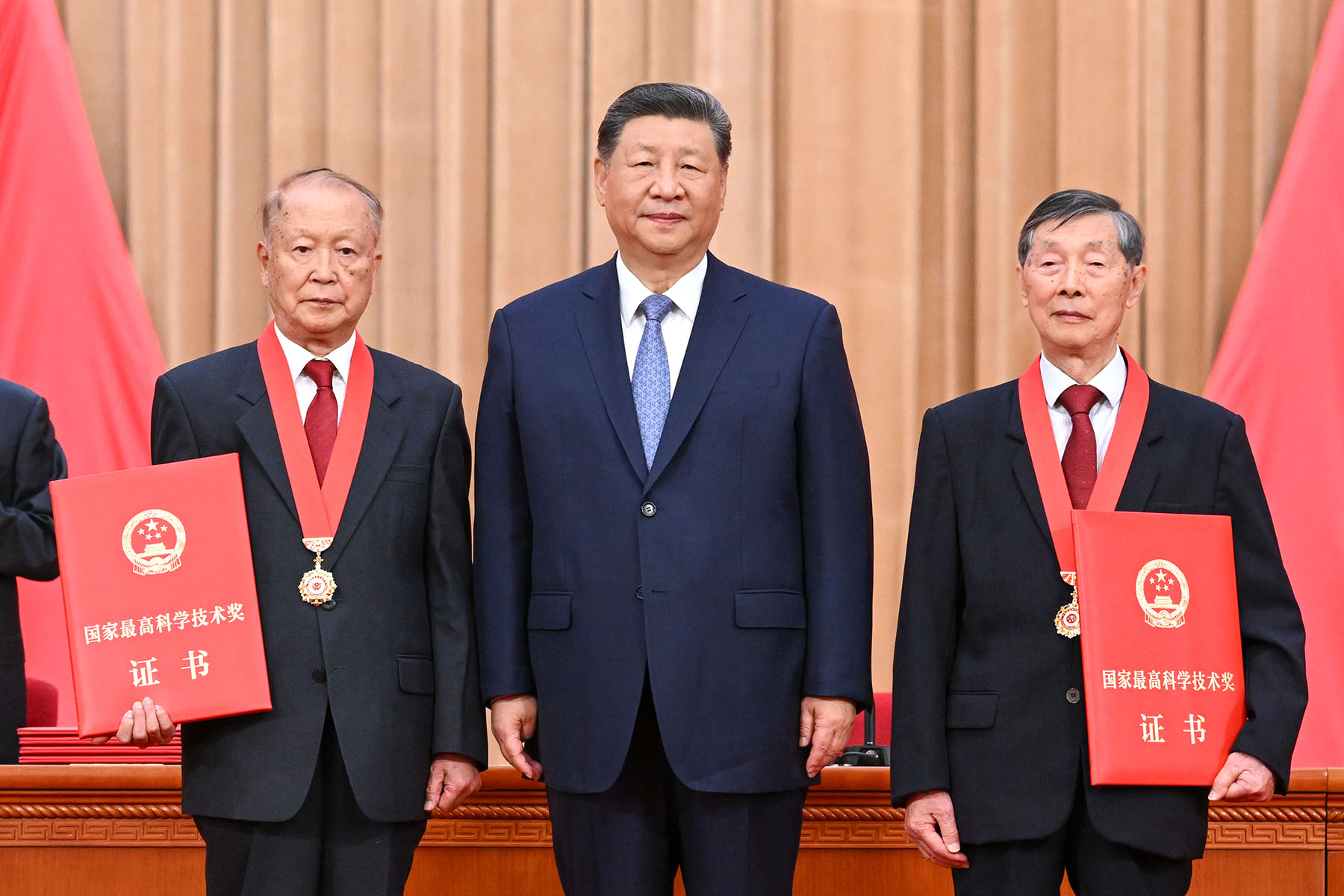
President Xi Jinping called on July 8 for accelerated efforts to achieve high-level self-reliance and strength in science and technology, saying that China must press ahead toward the goal of becoming a leading country in science and technology by 2035 and ensure that sci-tech innovation provides solid support for and guidance to Chinese modernization.
Xi, who is also general secretary of the Communist Party of China Central Committee and chairman of the Central Military Commission, made the remarks while addressing a meeting in Beijing.
The meeting brought together the national science and technology award conference, the general assemblies of members of the Chinese Academy of Sciences and the Chinese Academy of Engineering, and the 11th national congress of the China Association for Science and Technology.
Since the 18th National Congress of the CPC in 2012, China has made historic achievements and undergone historic changes in science and technology, Xi said, adding that the country is accelerating its shift from a participant and contributor in global sci-tech development toward a pioneer and leader in innovation, with a rise in innovation capacity that is among the fastest in the world.
Xi stressed that a new round of scientific and technological revolution and industrial transformation is profoundly reshaping not only the way people live and work, but also the global development landscape.
China must adapt to the new circumstances and requirements, take more forceful measures to effectively address problems in its sci-tech development, and fully implement the CPC Central Committee’s plans and arrangements for sci-tech work, he said.
China must bolster its capacity to make systematic breakthroughs in sci-tech innovation and improve the overall efficiency of the national innovation system, Xi said.
He called for a focus on frontier fields such as artificial intelligence, quantum technology, and life sciences; key areas including integrated circuits and advanced manufacturing; and strategic fields such as the deep sea, deep space, and deep Earth.
Major projects and programs should be deployed in an integrated manner, while original innovation and breakthroughs in key and core technologies should be advanced in a coordinated way, he said.
Xi emphasized the need to promote the deep integration of sci-tech and industrial innovation and to open up channels to accelerate the transformation of scientific and technological advances into real productive forces.
He urged efforts to strengthen the national technology transfer system, create diversified application scenarios and high-level industrial clusters, and promote the application and iterative upgrading of independently developed technologies and products.
The future of science lies in the youth, Xi said, calling for improved mechanisms to integrate science and education in talent cultivation and for greater efforts to foster outstanding young sci-tech talent.
He said support for researchers should be increased, and more teenagers with scientific potential should be encouraged to pursue careers in science and technology.
He also said China should seize the window of opportunity created by global talent flows and actively attract outstanding young talent and teams from overseas.
During the 14th Five-Year Plan (2021-25) period, China’s total social investment in research and development maintaine日d an average annual growth rate of 10 percent, with R&D intensity reaching 2.8 percent in 2025, exceeding the average level of Organization for Economic Cooperation and Development countries for the first time.
This has not come easily and fully reflects the firm resolve of the Party and the country to develop science and technology, Xi said.
Xi stressed the need to make sci-tech innovation investment more effective, ensuring that increased investment is matched by greater efficiency.
He called for deepening reform of sci-tech evaluation and making good use of it as a guiding tool for scientific research and innovation.
Xi also said that China must bolster sci-tech ethics and security governance, and promote the development of sci-tech in a way that is beneficial, safe, and controllable, so that it better serves the people.
At the meeting, Xi presented China’s top sci-tech award for 2025 to Chen Liquan, a pioneer in China’s lithium battery sector, and Ben De, a radar technology expert.
The July 8 meeting honored 258 projects and 11 scientific and technological experts. In addition, the China International Science and Technology Cooperation Award for the year 2025 was conferred on nine foreign experts.
Contact the writers at mojingxi@chinadaily.com.cn
