

WASHINGTON/TEHRAN/MUSCAT/ISLAMABAD – Iran's Islamic Revolutionary Guard Corps (IRGC) said on Thursday that it attacked US military bases in Kuwait and Bahrain in response to fresh US strikes.
According to a statement from the IRGC carried by Iran's Press TV, the IRGC struck key infrastructure and facilities at the Camp Arifjan and Ali Al Salem Air Base in Kuwait, as well as US military bases in Bahrain's Juffair and Sheikh Isa, "in the first phase of a punitive response against the American treaty-breakers."
The IRGC also warned that its responses would expand to other bases in the region if the US renews its attacks.
US forces strike Iran for the second straight day
US forces conducted strikes against Iran for a second straight day on Wednesday to "degrade" Iran's ability "to threaten freedom of navigation in the Strait of Hormuz," the US Central Command said.
The US is "holding Iran accountable for recent unjustified aggression against commercial shipping and civilian crews freely navigating a vital international waterway," the command said in a post on X.
More than 20 US Navy warships were patrolling waters across the Middle East on Wednesday, the command said in an earlier post.
The move came after US President Donald Trump warned at the NATO summit in Ankara earlier the same day that the US military would probably hit Iran again.
"I'll give a little warning: We're going to hit them hard tonight," Trump said, adding that he did not expect a full-fledged conflict with Iran.
Following Trump's remarks at the summit, Iran's Press TV, citing an informed source, reported that Iran would close the Strait of Hormuz and strike twice as many targets given any fresh US attack.
Meanwhile, the Iranian Army announced Wednesday eight of its forces were killed in US strikes earlier in the day in the southern provinces of Hormozgan and Bushehr.
ALSO READ: China urges dialogue after US, Iran trade strikes
In a statement on its website, the army identified those killed as Ali Moeini, Ali Mehdizadeh, Hamed Davvari, Amir-Hossein Qassemi, Alireza Zarei Sani, Alireza Balideh, Shahab Omidi and Mohammad Javad Ravanfar, vowing to avenge "the country's martyrs."
Earlier on Wednesday, state-run IRIB news agency reported a serviceman of the Navy of Iran's Islamic Revolution Guard Corps (IRGC) was killed in the US strikes in the port city of Bandar-e Mahshahr, southwestern Iran's Khuzestan province.
Tehran slams US attacks
Also on Wednesday, Iranian Foreign Ministry condemned US "aggressive" attacks, calling them a flagrant violation of the UN Charter and a recently signed peace memorandum of understanding (MoU).
Recurring US attacks, along with a Tuesday decision by the US Treasury to revoke a license for Iranian oil sales until Aug 21, disruption of Iranian arrangements in the Strait of Hormuz, and Israeli "military aggression" against Lebanon, have rendered "important and fundamental" parts of the MoU ineffective, it said in a statement.
'Violations of UN Charter'
Meanwhile, Iran condemns "in the strongest possible terms" the US's "repeated acts of aggression" and persistent violations of the Charter of the United Nations and other applicable rules of international law, an Iranian official said on Wednesday.
In a letter addressed to UN Secretary-General Antonio Guterres and the president of the Security Council for July, Iran's permanent representative to the United Nations Amir Saeid Iravani said the US has once again launched large-scale military attacks against installations in southern Iran.
"These renewed acts of aggression constitute another flagrant violation of Article 2(4) of the Charter of the United Nations and a material breach of paragraph 1 of the Islamabad Memorandum of Understanding," he said.
The deliberate targeting of civilian facilities, coupled with the continued unlawful use of force against Iran, "constitutes a grave threat to international peace and security and further demonstrates the US's complete disregard for its international legal obligations," the ambassador said.
Iran 'could pull out of NPT'
A senior Iranian lawmaker said on Wednesday if the US attacks Iran again, the country's options will include withdrawing from the Non-Proliferation Treaty (NPT) and changing its nuclear doctrine.
Ebrahim Rezaei, spokesman of the Iranian parliament's National Security and Foreign Policy Committee, made the remarks in an interview with the semi-official Fars news agency.
"If the United States attacks our country again, we will respond with all our might and are ready to give a decisive and powerful response to the Americans," Rezaei said.
"In the future confrontation, the enemy will face an all-out and surprise offensive from Iran that will not be limited solely to the military field," he said, stressing that Iran will employ all its capacities and capabilities in the "the axis of resistance," and crush the US assets and forces in the region while focusing concurrently on other strategic options.
He noted that closing the Bab el-Mandeb Strait in addition to the Strait of Hormuz is one of the options, adding that the other one is withdrawing from the NPT, which will probably be placed on the agenda, and the parliament is ready to discuss the plan.
Omani, Saudi foreign ministers meet on Hormuz security
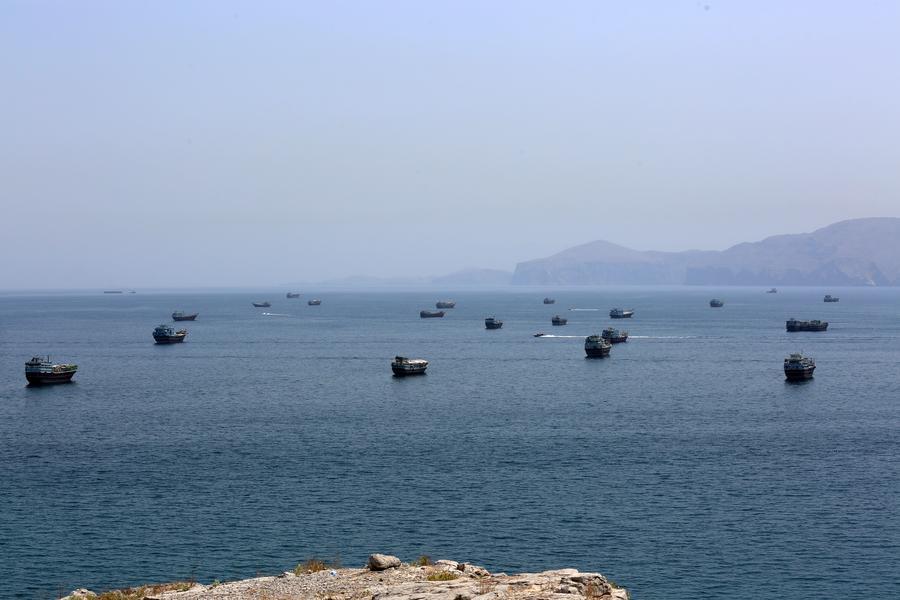
Omani Foreign Minister Sayyid Badr bin Hamad Al Busaidi met on Wednesday with his Saudi counterpart, Prince Faisal bin Farhan Al Saud, to discuss maritime security in the Strait of Hormuz.
The two ministers exchanged views on regional developments related to navigation through the Strait of Hormuz and underscored the strategic importance of the waterway to global trade and energy, according to a statement issued by Oman's Foreign Ministry.
They urged diplomatic solutions to ease regional tensions and safeguard the safety and freedom of maritime navigation, the statement read.
The ministers also reviewed bilateral ties and reaffirmed the importance of sustained coordination.
Pakistan urges all parties to exercise restraint
Pakistan has expressed deep concern over the escalating tensions in the Middle East, urging all parties to exercise restraint and resolve differences through dialogue and diplomacy.
In a statement on Wednesday, the Foreign Office said renewed conflict between the US and Iran was "in no one's interest" and called on all sides to refrain from actions that could further undermine regional peace and stability.
"There is no alternative to continued engagement, dialogue and diplomacy to achieve the shared goal of peace in the region," the statement said.
The Foreign Office also urged all parties to uphold their respective commitments under the Islamabad Memorandum of Understanding, describing it as "an enduring foundation for understanding, mutual respect and shared prosperity for the region and beyond."
Pakistan remains ready to continue playing its role in supporting regional peace and stability, it added.
