

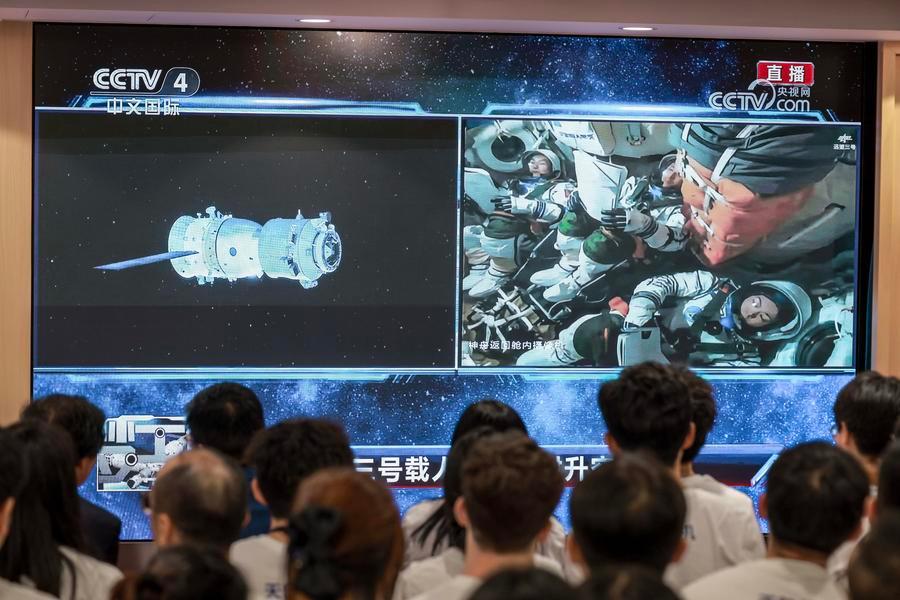
BEIJING – Lai Ka-ying, the Hong Kong Special Administrative Region's first astronaut, and her two colleagues on the Shenzhou XXIII spaceflight mission have conducted their first in-orbit medical rescue training since arriving at China's Tiangong space station, a video released by the China Manned Space Agency (CMSA) has shown.
The training aimed to help Lai and her fellow astronauts Zhu Yangzhu and Zhang Zhiyuan familiarize themselves with rescue operation techniques and force application characteristics under microgravity conditions, the CMSA said in the video Sunday.
In addition to the medical training, the crew has been engaged in a wide range of scientific experiments. They utilized a space Raman spectrometer to study the relationship between gut microbiota and nutritional metabolism under long-duration spaceflight conditions.
ALSO READ: Hong Kong’s first astronaut sets example for young talent
Behavioral experiments on visual motion processing and intuitive physics in microgravity were performed, exploring how gravity affects visual information processing and how long-term spaceflight impacts intuitive physics perception. The crew also conducted in-orbit emotion recognition and emergency decision-making capability assessments.
China launched the Shenzhou XXIII crewed spaceship on May 24. The mission is notable for including a one-year in-orbit stay experiment, which will provide crucial data for future long-duration space exploration.
