

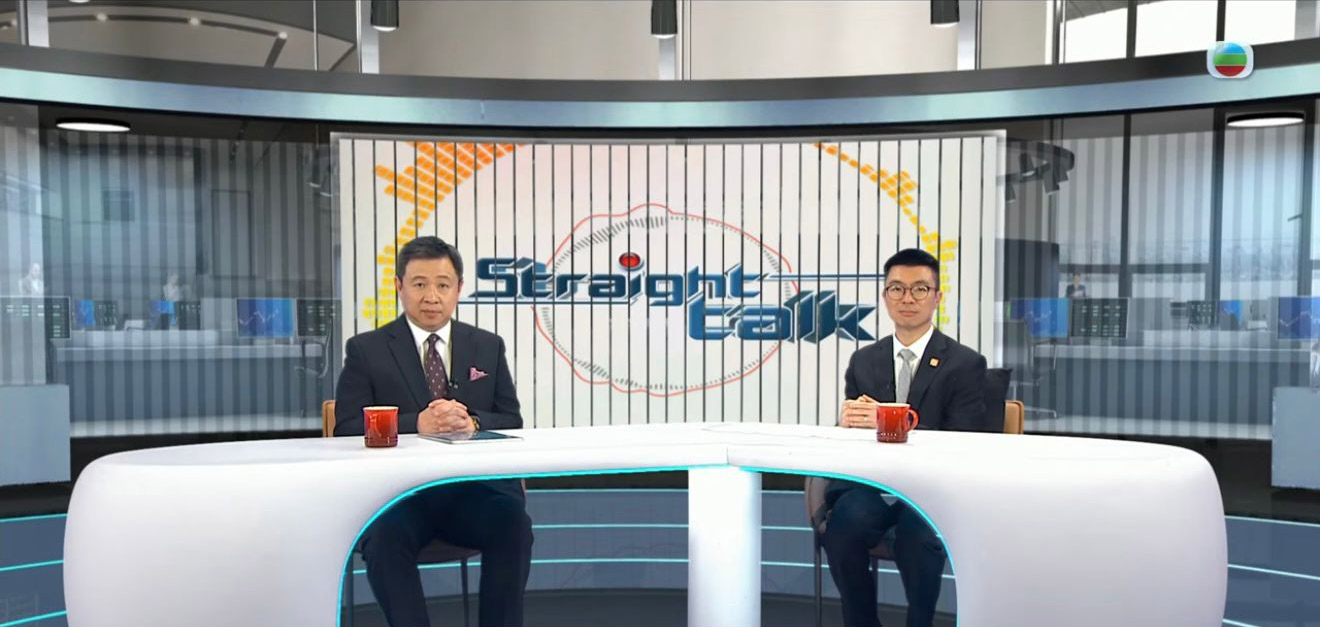
On Straight Talk this week to continue the conversation about Hong Kong's first astronaut and what that means for our city is Anderson Shum, president of the Hong Kong Young Academy of Sciences. Shum tells us how our city already has the potential and can seize the opportunity to contribute even more to our nation's 15th Five-Year Plan.
Check out the full transcript of TVB’s Straight Talk host Eugene Chan Kin-keung’s interview with Professor Shum.
Chan: Welcome to Straight Talk. I'm Eugene Chan. Joining us this evening to continue the conversation about Hong Kong's first astronaut and what that means for our city is Professor Anderson Shum, president of the Hong Kong Young Academy of Sciences. Educated at Princeton and Harvard, Shum is one of Hong Kong's leading scientists and innovators whose work has earned international recognition across a range of cutting-edge fields. As a researcher, educator, and advocate for talent development, he's well-placed to help us explore what the space age could mean for Hong Kong's next generation. Professor Shum, welcome to Straight Talk for the first time.
Shum: Thank you, Eugene.
Historic moment – implications for HK
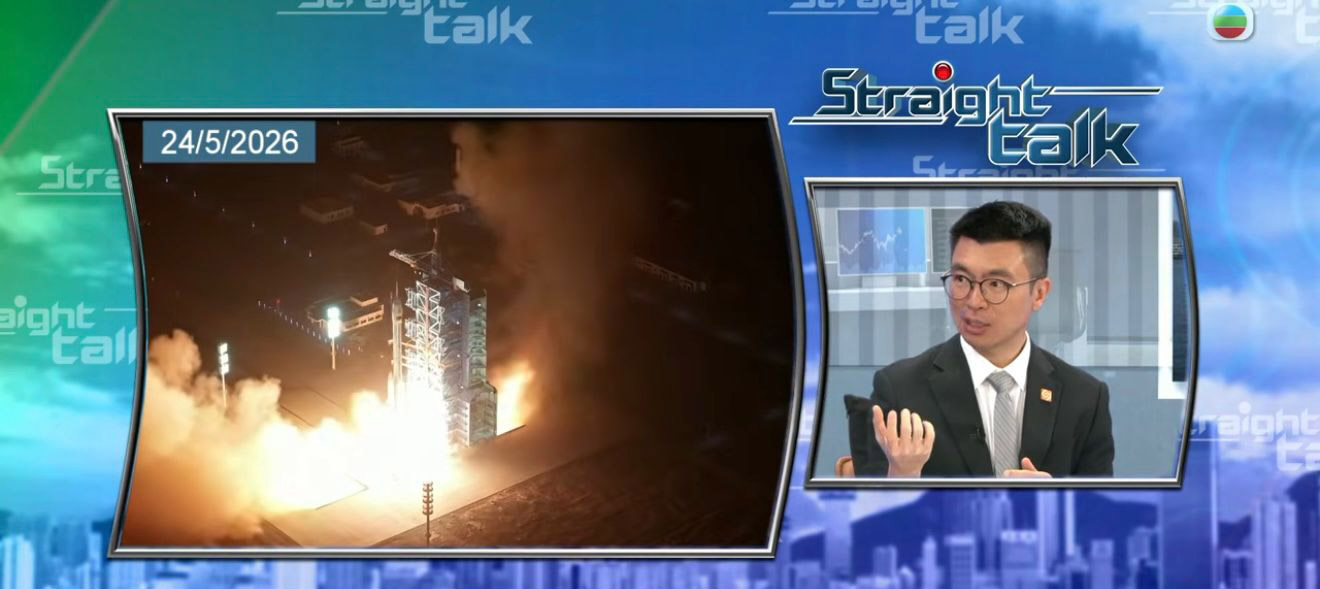
Chan: I understand that you and Professor Li Yilang, who came last week, also attended the Shenzhou XXIII launch at the Jiuquan Satellite Launch Center, nearly two weeks ago, or just over two weeks. I have to ask the same question: how do you feel when you actually see it, with the actual rocket going up, when you're there?
Shum: It was incredible because I think we have been seeing rocket launches maybe only on TV, but being able to see it, hear it, feel it on site is a very special feeling. What is even more special is knowing that we have a Hong Kong payload specialist in the rocket. I think it's like a dream come true to witness the historical moment.
Chan: Yeah. Was there a split second when you're watching the rocket going up that you had your fingers crossed, making sure everything goes smoothly? Were you at any stage worried at all?
Shum: I think I was too excited to think about that and also, as a scientist, I was very much amazed by how precise and how well-controlled such explosions and flames are going up, driving the rocket in such a precise manner, and I think, to me, that was very incredible.
Chan: We talked a bit before the show, and I asked you how long it needed to travel to Jiuquan. Maybe you can share with the viewers how easy the trip was. Was it a smooth ride?
Shum: First to get to the Jiuquan area, we have to take a flight, but there's no direct flight from Hong Kong to Jiuquan, so normally you have to connect maybe uh at Beijing or Chengdu; there's also a direct flight from Guangzhou to Jiuquan. The flight from Guangzhou to Jiuquan is about four hours, but then from the Jiuquan airport to the actual satellite launch location it takes another four to four and a half hours. So, it's pretty far.
Chan: Right. Is it quite a deserted area when you when you're there or were there a lot of people there as well?
Shum: The Jiuquan area is pretty much a city, and on the flight to there, you actually see a lot of beautiful mountains, etc. And then when you travel on the shuttle from the Jiuquan city to the launch location, you gradually get into more empty land and fields, and it feels more like you are entering the launch site. And once we arrived there, there were already quite a lot of people gathering around there, I think, awaiting this exciting moment.
Chan: Right. Did people have special permits to be there or could just anybody be there? I'm just wondering.
Shum: I'm not 100 percent sure, but my feeling is that when there is no launch, it could be open to outside people for tourists, but when there was a launch, there was an area that we have to register first. The bus has to get registered before it can enter the area.
Chan: All right. So, if you're given another chance, will you want to watch another rocket launch?
Shum: Sure. I think it's not common that you can go there and see it so close.
Chan: Right. And let's move on from your experience now. I know that you are a scientist, you are the president of the Hong Kong Young Academy of Sciences, and you told me that you have a group of young scientists that are very keen to do R&D for Hong Kong.
Shum: Definitely.
Chan: So, how do you see this launch exercise? I mean, you were there yourself. Has it changed anything, or would it change anything?
Shum: I think as scientists, we always try to break new boundaries, and I think in the past for us, for young scientists in Hong Kong, space is a kind of boundary, but now being able to see that Hong Kong people also have opportunity to be payload specialists and also experiments, instruments etc. can join the launch to the space and actually conduct experiments on space. I think that is very special, and to me, as a scientist, that breaks certain boundaries. So, we know that some of our experiments because some of the fundamental questions you have to conduct them at very special environment, including space. So, in the past that may not be possible but now it becomes possible and I think that tells us that working with our nation, being part of our nation, allows us to really do things that we could only imagine in the past, but now it could become a reality. So, I think that is very inspiring to scientists in Hong Kong.
Chan: Right. That means for Lai Ka-Ying's trip, not only has she made history for Hong Kong, being the first astronaut in space, she's a fourth Chinese lady to be in space, and actually the first Chinese payload specialist in space. Apart from all that, she actually has inspired all of you to say, “Hey, we are very close to it, or we could be part of it.”
Shum: Yes. I think definitely the impact or the implications are in the aerospace area. But I think it can go beyond that because I think it's very symbolic that even in space, Hong Kong scientists have the ability to access. But then I think besides aerospace, there are also many other scientific disciplines that in the past, maybe Hong Kong scientists feel that is too distant. But I think having this symbolic breakthrough, it gives us hope that there are boundaries that we can potentially cross as well.
Chan: Professor Li was here last week, and he told us that there are a few universities in Hong Kong that have space, sort of space work, or space program, that actually we have our instruments actually being part of the nation's development. For example, for the University of Hong Kong, they have a spectrometer for the Tianwen 1 and Tianwen 3 for the Mars mission. But interestingly, I've been in public service for so many years, we have hardly heard of such achievements. Why is it that all these great achievements have been under the radar for so long? Maybe you can tell us.
Shum: That's also one of the missions that we have in the Hong Kong Young Academy of Sciences. We feel that Hong Kong scientists, especially young scientists, are very capable and doing a lot of exciting science and innovations. But part of it, as you mentioned, may not be heard by the general public. And I think, so what we try to do is science popularization and also trying to organize a lot of programs and events for even younger children and secondary school students, primary school students, for them to get to know what Hong Kong scientists are doing, what are some of the exciting areas that Hong Kong scientists also have been making important contributions to.
Chan: Right. You know that Hong Kong has been known for finance and also our professional services. And now, suddenly, we realize education, as we know, actually even more for sciences, that we have a role to play. So, where do you see Hong Kong play further into our nation’s sort of scientific development? Is space the only area, or are there areas that you can actually identify?
Shum: I think there are lots of other areas. Space is certainly one of the ones that I think is getting a lot of attention because of the involvement in the Shenzhou XXIII. But there are also many other areas such as life and health technologies, AI, etc. And I think that's one of the reasons why, as scientists, we are very encouraged to see that in our nation's 15th Five-Year Plan, we have been designated as the international innovation and technology center. And also, I think we also have the aspiration to become the international hub for high-caliber talents. And that allows us to attract a lot of world-class scientists and top talents to come to Hong Kong to work together because talents like to work together. And when talents work together, the sky is the limit. And now even space is not the limit.
Inspiration to youth
Chan: Right, exactly. You know that the word STEM has been used a lot, and in Hong Kong, we have a Hong Kong Academy of Gifted Education, whereby the students are given chances to be exposed to courses, international competitions, or even field trips. So, as scientists yourselves, where do you see this bringing our students? Because, traditionally, the students would want to do medicine or law, right, as many of the students who came. What field can they do? I mean, of course, everybody wants to be an astronaut, but there's only one Lai Ka-ying. What are the jobs out there?
Shum: To me, I think innovation and technology is not just a discipline, not just a type of job. I think it's a culture. I think as we embrace science and technology, innovation and technology, we become more innovative. And part of being more innovative is also to be more entrepreneurial with what we do with our scientific discoveries and technological developments. And I think that type of entrepreneurial spirit has been in the DNA of Hong Kong people. And so I think now, science and technology just gives a new avenue for Hong Kong people, especially the young people, to exercise their creativity and their ability to explore their entrepreneurial spirit. So, I think it's very exciting, and it spells very good for Hong Kong's future.
Chan: Right, Anderson, it's time for our short break now. We'll be right back with more Straight Talk.
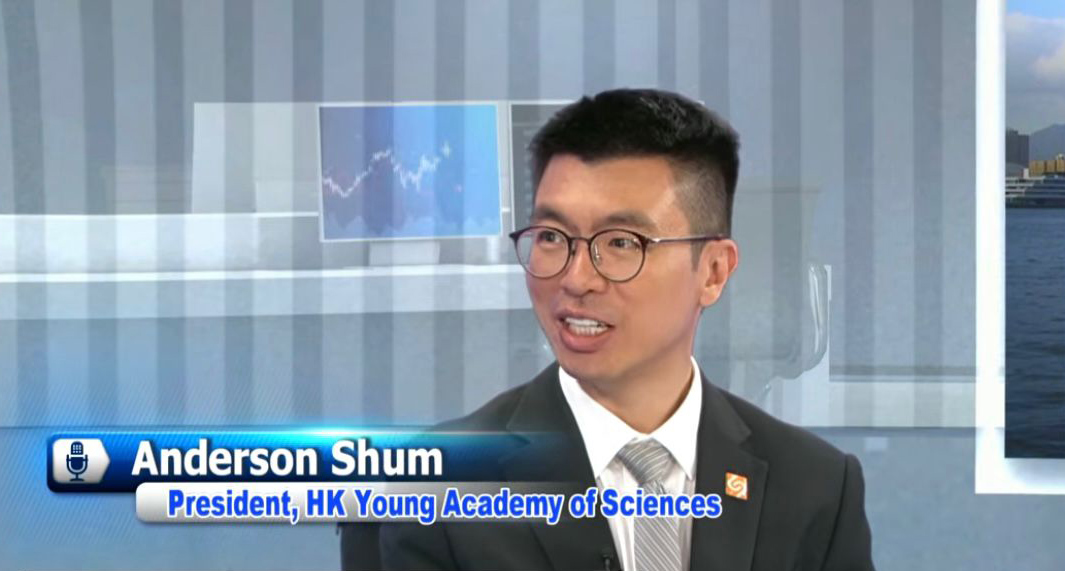
Chan: Welcome back to Straight Talk. We are talking to Professor Shum, president of the Hong Kong Young Academy of Sciences, about our city's first astronaut in space and the broader implications for education, innovation and talent development locally. So, Anderson, I think you have rightly pointed out to the viewers one very important term right at the end of the first part – entrepreneurial. Because entrepreneurship is in Hong Kong people's DNA, and now if they have seen “I&T” has this possibility, people are going to come in. So, let's go back to your Hong Kong Young Academy of Sciences. Can you tell us a bit more? I mean, this is a young organization. What will be your objectives and why do we need an academy, especially for the young people?
Shum: Thank you for asking that. It is the chapter of the Hong Kong Academy of Sciences established in 2018. Now we have about 73 young scientists as our members. All of our members come from different institutions in Hong Kong. They are all very much, I would say, experienced, even though we are young, in science and in research and in a lot of our innovations as well. I think it is set up by the Hong Kong Academy of Sciences to encourage young scientists to have our voices also heard in multiple areas. For example, in popularizing science, in advocating policy, in encouraging academic exchanges, and also liaison, for example, with the industries and also important stakeholders. So, I think we are very honored and very pleased that we have a voice where young scientists with experience in our universities, with our research, with our network in the international and mainland academic communities, to get together and share our experiences and sometimes what we are going through, what we think will be really good for Hong Kong's technological developments.
Chan: I think personally, I'm very encouraged to hear when we have such a young academy, because as I said earlier, you have such good achievements, and if the public doesn't know about it, it's a waste. And also, a lot of people miss out on the chance of actually investing, as we were talking about entrepreneurial work. I'm going to ask you a very direct question.
Shum: Sure.
Chan: Out of the 73 scientists, right, how many are local born and local bred that all, we have many sort of lecturers from all over the world joining Hong Kong, and they're part of the academy.
Shum: I do not have the statistics off the top of my head because we don't focus on that. As long as you're in Hong Kong, part of the Hong Kong family, you're included. So, we try to encourage and include all our Hong Kong young scientists. And I think, just incidentally, and also that speaks to the strength of Hong Kong, almost all of our members would have extensive experience overseas, in the mainland. And therefore we are very well exposed to the communities in science, in technology, in innovation all over the world. And therefore we speak science as a common language, and we try to speak for Hong Kong young scientists. And so as you mentioned earlier, it's very important to share what we know about our sciences to the community. So, we have our members going to secondary schools, going to newspapers, to writing columns about the latest technological developments. And I think these are very helpful. Also for us as scientists, we get inspired when we talk to lay people, talk to students, talk to our community.
Challenges for Youth
Chan: Right. When you were talking about going to see students in schools, I'm sure you want to encourage them not only to study sciences, but to pursue a career in I&T. I'm sure the viewer is going to say to me, “Hey professor, not everybody can be as smart as you, go to Princeton and all these big universities, come back and be a professor and done their PhD.” If you're going to pursue a career in I&T, what challenges do you think they'll face right now?
Shum: I think the challenge is exactly that we cannot tell or encourage what the students should be doing by saying what we want to say. I think we want to be examples. We want to share examples of others that we've known. Maybe some of our members are examples, maybe some of the former students and collaborators are examples. We want to share the messages about scientists, about innovators, about what a science education can do, not just to our own career, but to our city's future development.
Chan: Right. I'm sure, I think the result is going to come out soon for our DSEs and let's see what happens this year with people's aspirations. But it's not easy for somebody or the parent, when they're talking to the child about the field of study in the future, when you're having a more stable career in traditional professional jobs as compared to a science career. Like for example you talk about aerospace; there's a lot of money into it but it's going to take time. So, how are you going to convince young students, apart from doing something good for Hong Kong, that they should pursue a career like yourself?
Shum: I think the success of our students is very much tied to the success of our city, and I think advocating innovation and technology is not about getting everybody to be running startups, to be working in tech companies. I think one of the important messages is to encourage people to be more innovative.
Chan: Right.
Shum: It's sometimes more about the innovativeness rather than just the innovation, because no matter what we do, even including news reporting, even including media, innovativeness is very important. If we can be more innovative because we have this innovation mindset as our DNA, I think our city will become better and better.
Chan: If I'm going to ask you for some advice for our youth to study, especially given AI and all this recent news, right, what subjects should they be doing and what subjects should they not? They should sort of try to shy away.
Shum: My advice to my students usually is to pursue what you are most passionate about. Because when you're passionate about something, you're willing to spend more time on it, you're willing to sacrifice your personal time to pursue that. And after some time I think we all learn about compound interest in our school, so if you give it enough time if you keep compounding that additional effort, the results are going to be remarkable. So, I think our students should pursue things that they are passionate about, of course if it's aligned with our cities and our nation's overall strategic development plans, maybe the development will be faster. But I think the city is diverse enough to accommodate lots of different talents. So, if your passion is for something that you think can contribute to our society, the community, and even humanity, I think just pursue it with all your efforts, and the future will be bright.
Implications for I&T hub
Chan: Right. When you're talking about all these futures, I thank you very much for painting or allowing me to see a very bright future ahead. And you know, our government has invested heavily in the last few years in I&T. How would you assess the progress so far? Because you're in the science field. Are all these investments beginning to deliver sort of the desired results yet?
Shum: I think if you talk to our startup and investment friends, they can also tell you that startups are not always successful. In fact, I think many startups may not fly or may not be able to survive after some time. But I believe that the resources that we have put in will train a generation in a way that the people that are trained during the process through the investment will be successful. So, I believe that the people will be successful regardless of whether all the startups are successful as well. And I believe that many of our startups, of course, will end up being very important contributors to our economy. But I think, even more importantly, the people who have the experiences enabled by this investment will drive Hong Kong's future.
Chan: Right. Do we have enough talents in Hong Kong to help to make this happen?
Shum: I would always welcome even more talent and I think one of the things that we have demonstrated through this launch of the Shenzhou XXIII is that Hong Kong has tremendous potential, potential that you may not have imagined before and I hope that that also serves as evidence to help us attract talents from all around the world to come to Hong Kong, because of the great and promising potential that we have.
Chan: And let's go back to the 15th Five-Year Plan, a national plan. We've been talking more and more I&T focused. Do you see Hong Kong being able to contribute positively and effectively, and having a role as an international financial center? Do you think we have that capability?
Shum: I believe so because I think Hong Kong SAR, through the “one country, two systems”, we have some unique advantages, including our legal system that is very well connected through with other common law areas. And also I think the 15th Five-Year Plan rightfully assigns us as the international hub for high-caliber talents, because I think the lifestyle in Hong Kong is very friendly to talents from all over the world. And with our ambition and investment in innovation and technology that you have also mentioned earlier on, I think the potential that people can see is enormous, and I think if a lot of talents are able to come to Hong Kong and if we provide them with the right support and right resources to thrive, I believe that we can contribute to our nation in a very unique manner.
Chan: Right. I’m going to ask you the last question. I need a very brief answer.
Shum: Sure.
Chan: Being close to the Guangdong-Hong Kong-Macao Greater Bay Area and having “one country, two systems” in the city, do you see Hong Kong in a very advantageous role to help develop all the I&T for our nation?
Shum: Yes, because I think GBA areas provide some of the important things that Hong Kong cannot have very easily, including a large market and also including the possibility to scale up our research.
Chan: We have to leave it there for now. Professor Shum, thank you so much for sharing the insights with us. The Space Age brings wide opportunities beyond the launch pad. And our challenge is to equip our youth with the skills and resilience to seize them. Have a good evening and see you next week.
