

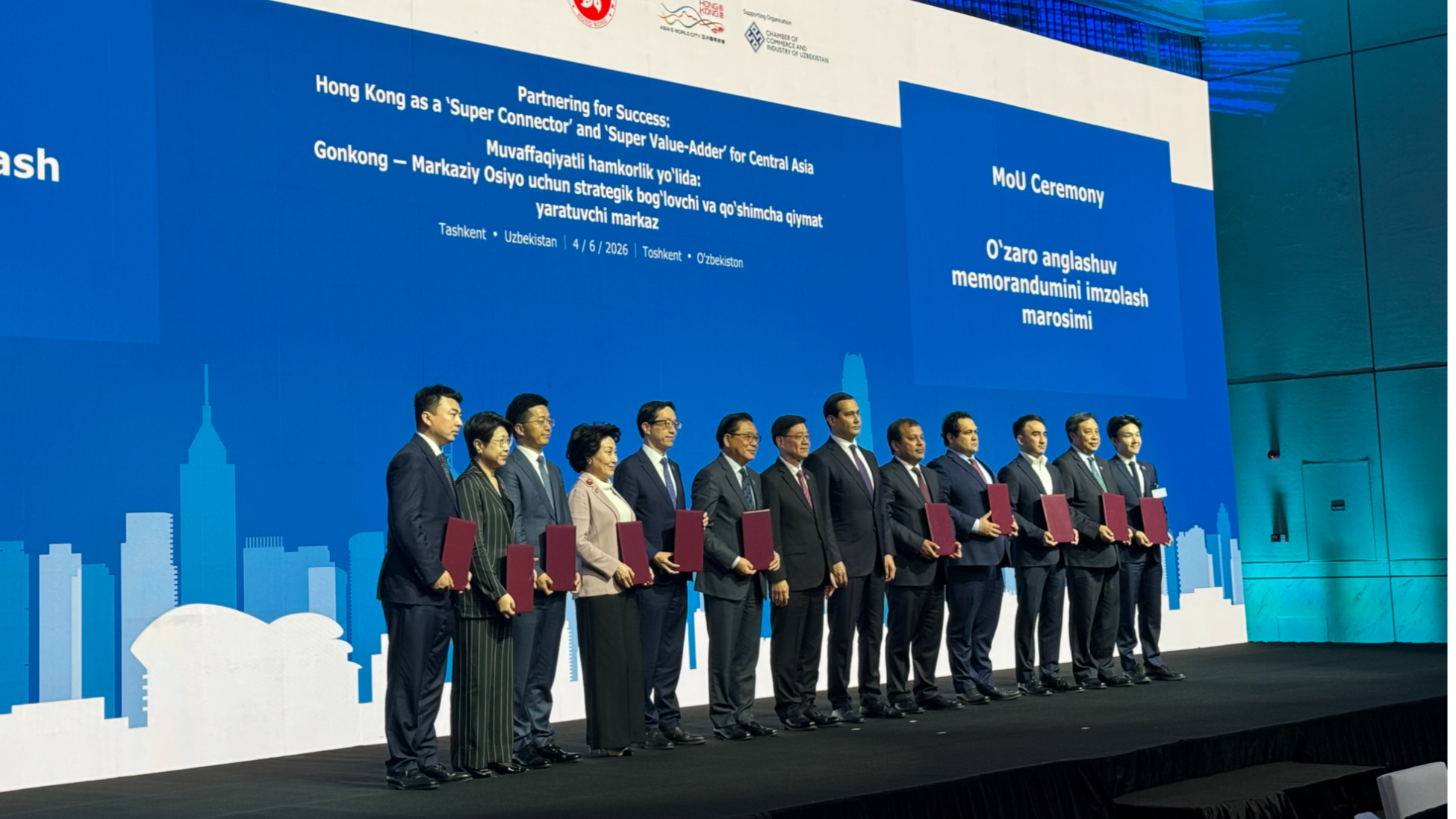
Delegates from the Hong Kong Special Administrative Region and the Chinese mainland have reached 96 agreements with Kazakhstan and Uzbekistan, involving $1.65 billion in investments across business, education and development projects.
The pact, including 15 government-level agreements, marked a fruitful high-level mission to the two Central Asian countries, led by Hong Kong Chief Executive John Lee Ka-chiu. The 70-member delegation, comprising Hong Kong and mainland business and professional leaders, began its weeklong trip on Sunday.
On Thursday in Tashkent, Lee met with Uzbekistan President Shavkat Mirziyoyev, Prime Minister Abdulla Aripov, and other senior officials, to discuss closer institutional and people-to-people ties between Hong Kong and the nation.
The two regions have agreed to begin talks on a mutual 30-day visa-free arrangement. Currently, Hong Kong SAR passport holders can visit Uzbekistan visa-free for 10 days, while nondiplomatic Uzbek passport holders need a visa to enter Hong Kong.
Uzbekistan also plans to open a consulate general in Hong Kong, which would be the city’s second Central Asian diplomatic mission after Kazakhstan’s. The SAR government will also consider setting up an economic and trade office in Central Asia.
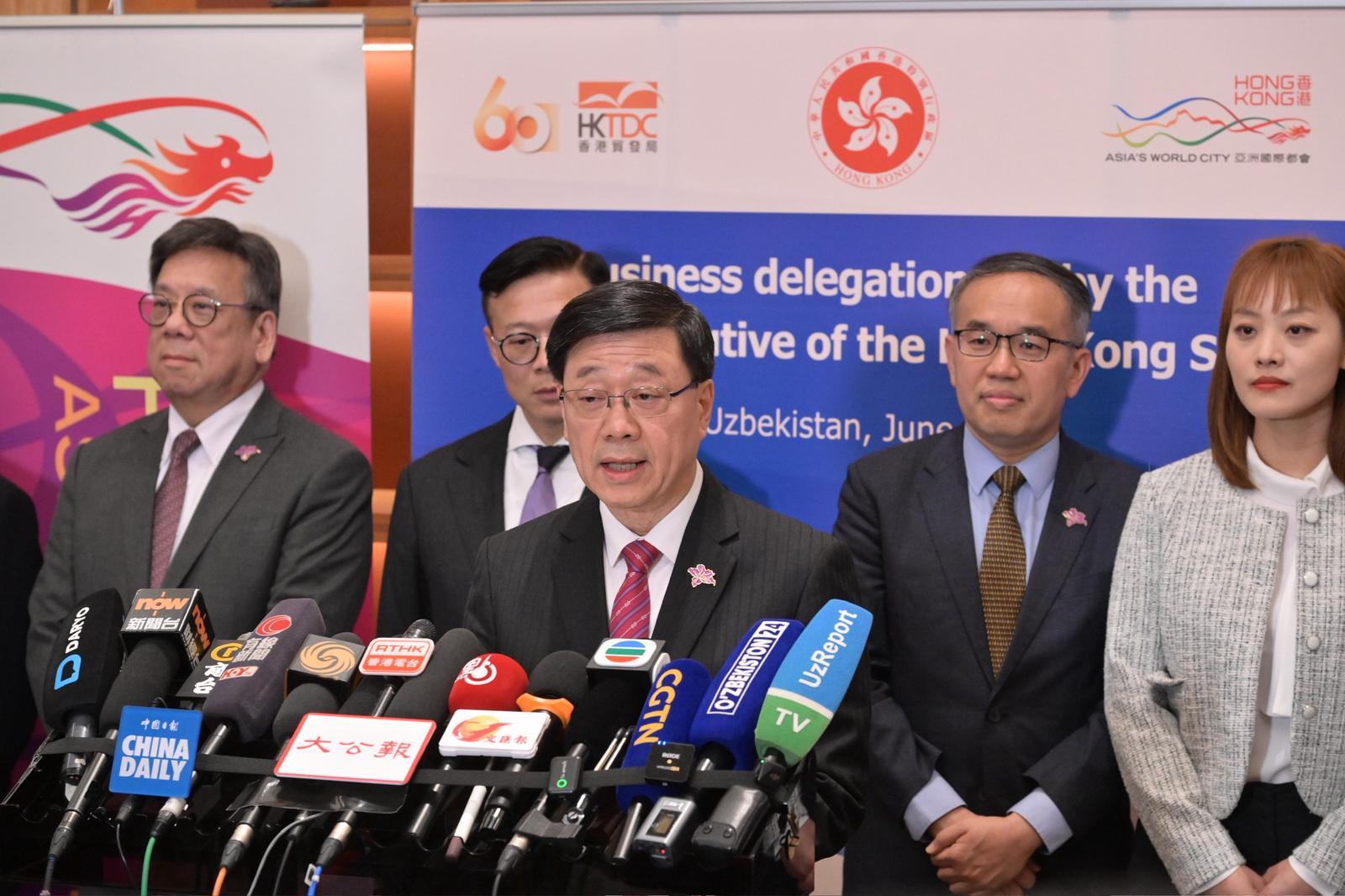
At a media briefing, Lee summarized the trip, during which the delegation held meetings with senior government officials, attended over 20 events, and visited several innovation and technology centers.
The delegates explored emerging markets, strengthened intergovernmental relations and exchanges, and advanced hub-to-hub collaboration, he said.
Jeffrey Lam Kin-fung, a council member of the Hong Kong General Chamber of Commerce, said that the chamber signed agreements with the largest chambers in Kazakhstan and Uzbekistan.
He called on the business community to capitalize on the new deals that will develop following the visit, and to reinforce Hong Kong’s role as a superconnector and super value-adder among global businesses.
Jackson Choi Chit-sze, 29, a director of Sun Wah Investment (Hong Kong) Ltd, and the youngest entrepreneur in the delegation, said he aimed to explore the Central Asian market as well as build connections with other delegates.
Choi said Central Asia has rich mineral resources, and that its natural environment gives the region an advantage in developing renewable energy such as solar power. He added that the region’s geographical location linking China and Europe makes it a key alternative logistics route.
Cliff Zhang, CEO and co-founder of Templewater — an Asia-based private equity investor and alternative asset manager — said the company has signed three agreements with organizations in Uzbekistan.
Zhang told China Daily that while it will take time to realize the benefits of such cooperation, he sees vast potential for the future.
For example, Central Asia’s rapid development is expected to spur strong demand for real estate — an area in which Hong Kong companies excel. On the financial front, there is also much that Hong Kong companies can do, Zhang added.
During a business dinner with local political and business leaders, Lee highlighted Hong Kong’s strengths in education, finance, law, and culture, while praising Uzbekistan’s rapid development and vast potential. Lee said that through the visit, the two regions have reaffirmed their mutual commitment to wide-ranging cooperation.
Sardor Umurzakov, adviser to Uzbekistan’s president on strategic development, echoed Lee’s remarks, describing the Hong Kong delegation’s visit as a significant step toward deepening collaboration and unlocking the country’s economic potential.
The delegation will also visit IT Park Uzbekistan, the country’s primary technology and innovation hub, before returning to Hong Kong.
Contact the writers at atlasshao@chinadailyhk.com
