

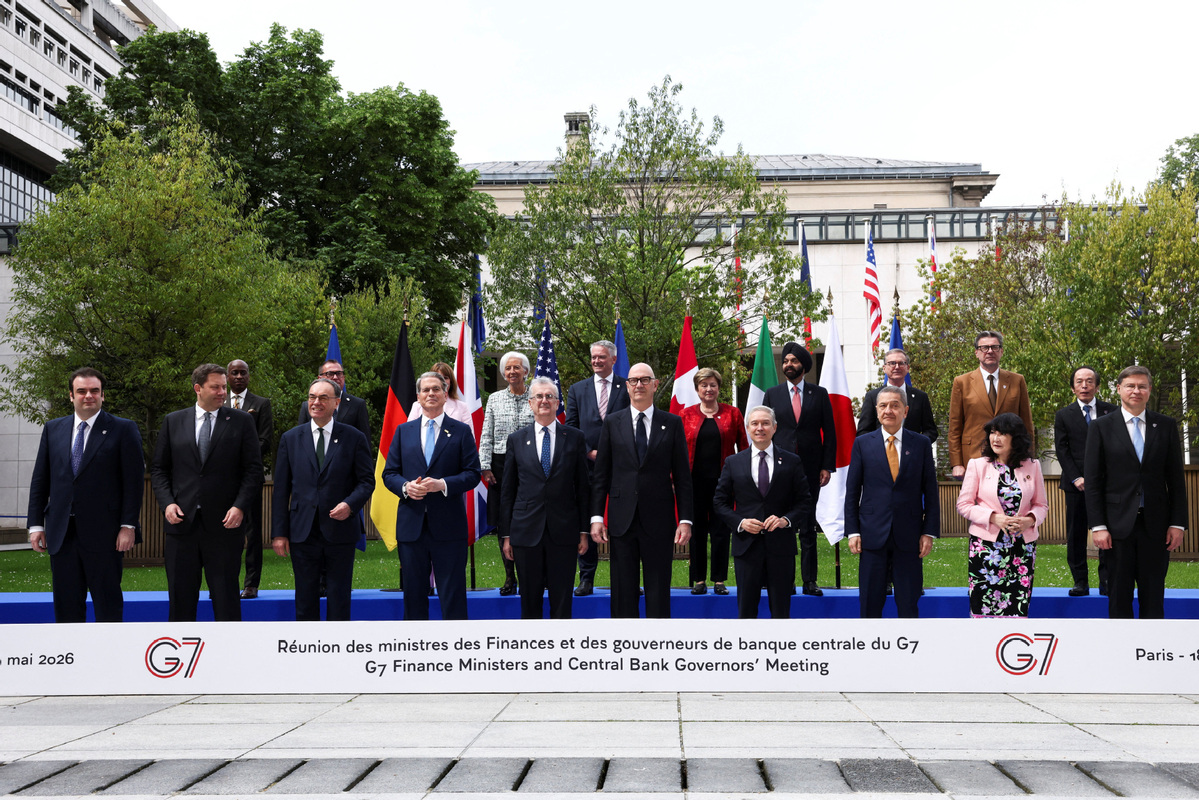
The gathering of G7 finance ministers in Paris from Monday to Tuesday has been framed, predictably, as another exercise in diagnosing the ailments of the developed economies through the prism of "imbalances". Yet what stands out clearly is not China's trade surplus as claimed, but the growing inability of some developed economies to confront the structural contradictions within their own economic systems.
Before the meeting, French officials spoke of an "unsustainable" global economy in which China "under-consumes", the United States "over-consumes" and Europe "under-invests".
The US runs chronic fiscal and current-account deficits because it has long chosen debt-fueled growth over fiscal discipline. Europe's investment weakness, meanwhile, reflects years of strategic hesitation, demographic stagnation and energy insecurity. Japan worries about bond-market volatility because decades of ultra-loose monetary policy dictated by Washington have left it exceptionally exposed to shifts in global capital flows.
READ MORE: China urges G7 to stop disrupting trade order with self-made rules
To hold China accountable for that is scapegoating to avoid self-correction. Trade balances are shaped by industrial structures, comparative advantages, corporate investment decisions and the international division of labor. China's trade surpluses with the G7 members, as well as the European Union, are the de facto objective result of policies designed and practiced by some advanced economies themselves.
For years, multinational corporations shifted production to China in pursuit of lower costs, industrial clustering and market access. The profits from these operations flowed overwhelmingly back to shareholders and corporations in developed economies. Yet the products manufactured in China and exported to Western markets are statistically counted as Chinese exports.
Some developed economies have systematically constrained their own export potential to China. Restrictions on high-tech exports have become increasingly expansive over the past decade. Advanced semiconductors, aerospace technologies, industrial software and precision equipment have all been subject to tightening controls. One cannot simultaneously suppress exports and lament trade deficits.
Indeed, China's own technological progress increasingly reflects this reality. The latest data on the BeiDou Navigation Satellite System offer a telling example. According to an industry white paper released on Monday, China's satellite navigation sector reached an output value of 629 billion yuan ($92.34 billion) in 2025, while the broader BeiDou spatial-temporal industry exceeded 1.3 trillion yuan. The system's products and services have expanded to more than 140 countries and regions.
What this illustrates is not merely industrial scale, but technological substitution. As some developed economies narrowed technology exports to China, the country accelerated indigenous innovation. Domestic supply chains have emerged with increasing levels of self-sufficiency.
The same pattern is unfolding in artificial intelligence, green energy and advanced manufacturing. China's preparation for the AI era, including the integration of AI across industrial production, logistics and services, is advancing at remarkable speed. So too is its transition toward renewable energy, electric vehicles and intelligent infrastructure. China's industrial upgrading has proceeded faster and more coherently than in many advanced economies.
This raises a deeper question for the G7. Has "de-risking" from China become a political slogan masking internal weaknesses?
Ironically, much of the "anxiety" voiced within the G7 club concerns instability emanating from the US — from its fiscal deficits and trade tensions to its sanctions policy and the geopolitical volatility it is engineering. For many developed economies, the more immediate form of "de-risking" increasingly involves reducing overdependence on US financial and strategic unpredictability.
ALSO READ: G7 should step forward onto right side of history
China, meanwhile, continues to expand its high-standard opening-up. It is already the world's second-largest import market, and its future import potential remains enormous as its industrial upgrading continues. New demand for services, consumer goods, advanced manufacturing and green technologies will create opportunities for trading partners.
The tragedy is that parts of the developed world still interpret China's rise primarily as a "threat" instead of an opportunity. The intent of globalization should not be that the prosperity of one side is at the expense of another. It should be that interconnected growth can enlarge the economic pie for all. If the G7 wishes to address its "imbalances", it should begin with a more uncomfortable exercise in self-examination.
