

With consecutive world champions, booming interest, nation tilts sport's balance of power
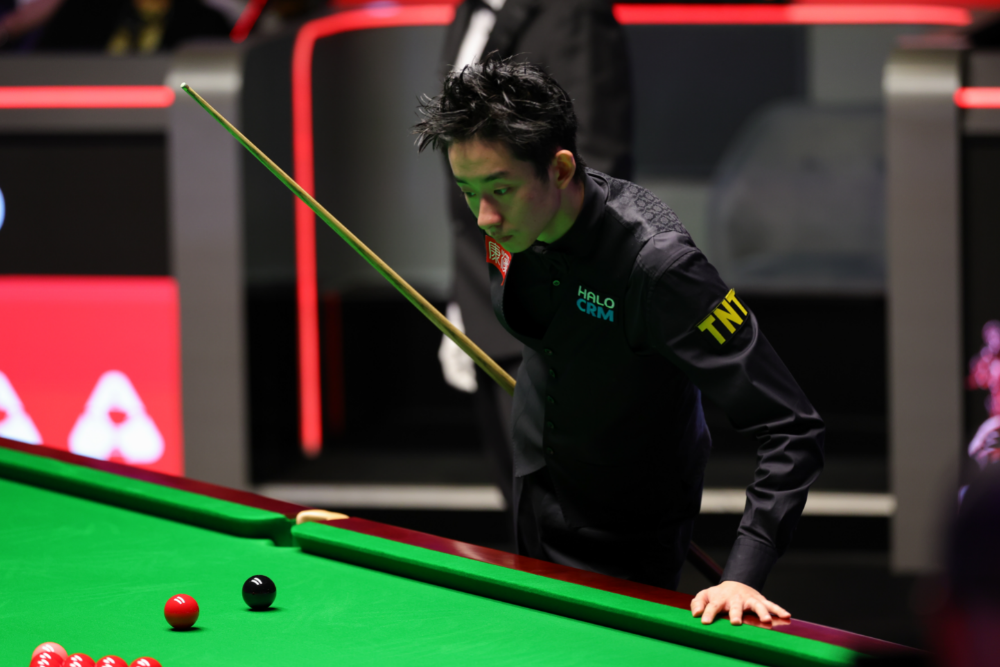
In the narrow backstage corridor of snooker's most storied arena, the Crucible Theatre in Sheffield, an unusual scene unfolded during the 2026 World Snooker Championship as three Chinese players from different generations prepared for another night on the sport's biggest stage.
Ding Junhui, 39, the pioneer of Chinese snooker, Zhao Xintong, 29, the then defending world champion, and Wu Yize, 22, one of the sport's rising stars, stood side by side in silence, waiting to walk out.
A backstage photograph captured the moment. It quickly resonated across China, where it was widely interpreted as a reflection of Chinese snooker's shift from isolated breakthroughs to generational continuity of excellence.
That belief was reinforced days later.
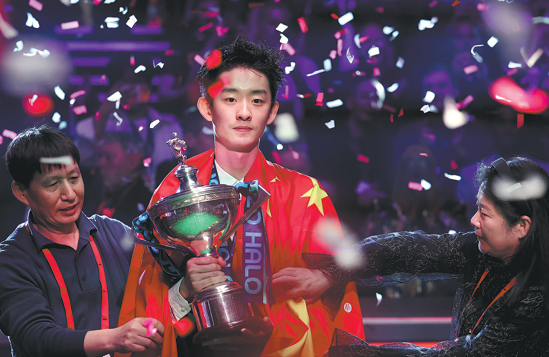
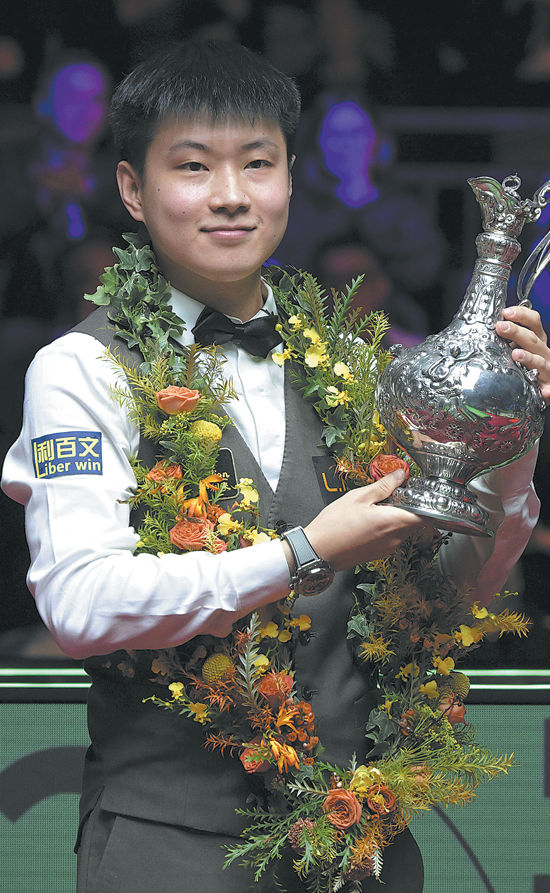
On May 4, Wu defeated England's Shaun Murphy 18-17 in a dramatic World Championship final. The match went to a deciding frame for the first time in more than two decades, highlighting both the tight competition at the elite level and the emergence of new contenders from China.
Under immense pressure in the final frame, Wu opted for an aggressive long shot on a red ball. The gamble paid off, shifting momentum in his favor.
ALSO READ: Wu becomes the second Chinese to win World Snooker Championship
"I have been trying to go for this for ages," Wu said after the match. "For the past few months, I have been living the same life. I am so happy that I could play well today."
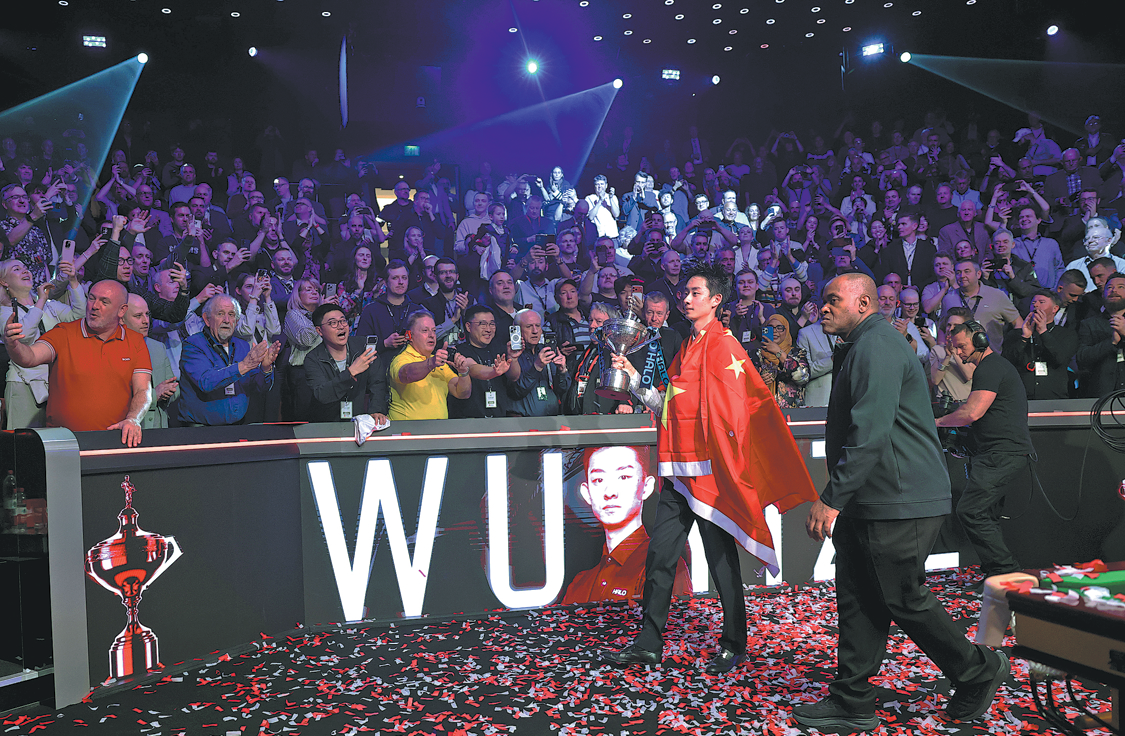
Former world champion Murphy, a veteran of the professional circuit, acknowledged the quality of Wu's performance. "I played the best shots I could and as a snooker player that's really all you can do," he said. "I don't feel like I lost the match — he won the match."
Wu's victory marked China's second consecutive world title, following Zhao's defeat of Mark Williams 18-12 last year.
Zhao became the first Asian player to win the World Snooker Championship. Zhao's breakthrough ended more than a century of European dominance, predominantly British, at the Crucible, while Wu's win confirmed that the result was not an isolated outcome.
The 2025-26 season has so far confirmed a clear shift in the balance of power, with Chinese players chalking up tournament wins on the World Snooker Tour circuit and climbing the player rankings.
Zhao, who won four titles, was named Player of the Year and inducted into the sport's Hall of Fame. Wu received the fans' Player of the Year award, while Chang Bingyu won Breakthrough Player of the Year.
ALSO READ: Snooker: World Grand Prix HK victory reasserts Zhao Xintong's return to top table
Collectively, Chinese players claimed seven titles — the strongest single-season performance in the country's history.
At the Crucible Theatre, 11 Chinese players entered the main draw of 32, the highest representation to date. Alongside established names were younger players including Fan Zhengyi, Lei Peifan and others who emerged through qualifying routes.
Inside the venue, Mandarin was increasingly heard in practice rooms and corridors, while Chinese flags appeared among traveling supporters.
Early breaks
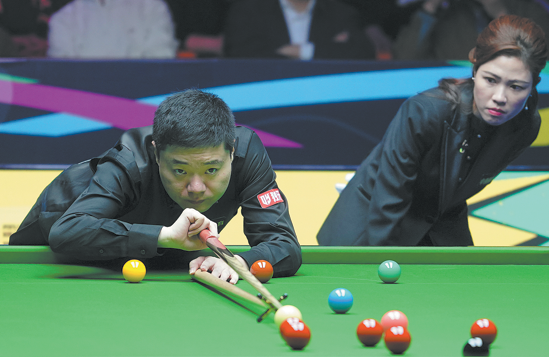
In the early 2000s, Ding Junhui emerged as China's first global snooker star.
In 2005, the then 18-year-old defeated superstar Stephen Hendry at the China Open, a landmark victory and a turning point in raising the sport's visibility in China.
At the time, China had only a small number of professionals playing abroad. Ding's early career was marked by isolation and limited support in Sheffield. But he established a path that later generations of Chinese snooker professionals would follow.
"Without Brother Hui, there would be no current generation of Chinese snooker players," Zhao has previously said.
Ding now works informally with younger Chinese players in Sheffield.
"From Zhao Xintong to Wu Yize, Chinese players have stood on the top podium for two consecutive years," Ding wrote after Wu's world title. "This is not just a breakthrough — it shows our time is coming."
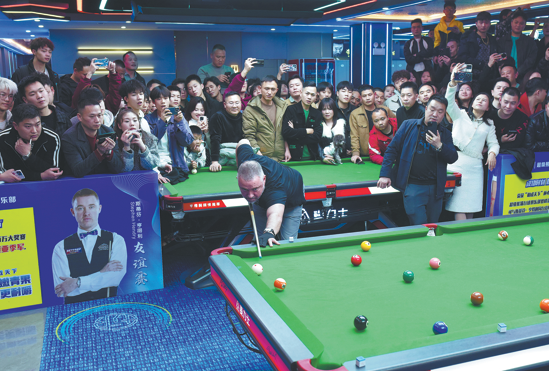
Unlike earlier generations, today's players are supported by a growing domestic network of academies, training centers and professional pipelines.
The shift from family-driven investment to institutional support is now widely recognized as key to the newfound success. Earlier players often relied on significant personal sacrifice.
Ding, for instance, began playing at age 8 in his father's grocery store. Once his talent was recognized, his father sold the family home and moved to Dongguan, Guangdong province, where Ding trained for more than 10 hours a day.
Wu followed a similar path. Born in 2003 in Lanzhou, Gansu province, he moved with his family to Dongguan at age 13 to join the Ding Junhui Snooker Academy, winning a national junior title the following year. He later won the World Junior U21 Championship in 2018, and was named Rookie of the Year in 2022.
From 16, he trained in the United Kingdom with his father, who supported him financially by working outside the sport. After his world title win, Wu said: "Since I made the decision to drop out of school, my dad has been by my side. My mum has not been in very good health. Since we have been in Sheffield, she has been staying a long time in hospital. She has sacrificed everything for me.
"My parents are the true champions … They are the source of my strength," he said.
Expanding ecosystem
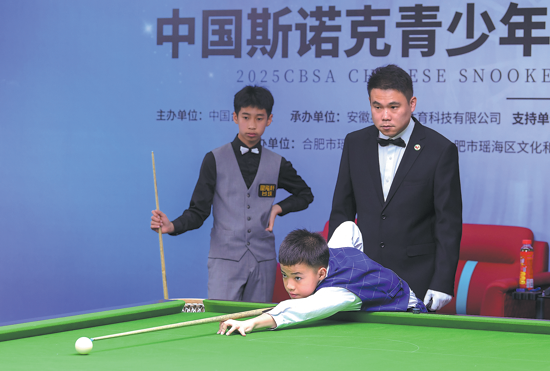
China currently has nearly 300,000 billiards clubs and an estimated 80-100 million enthusiasts nationwide, said Qiao Bing, vice-chairman of the Small and Medium Commercial Enterprises Association and president of the Billiards Industry Branch.
This massive grassroots base directly feeds the country's growing presence on the professional circuit. Over the past five years, junior participation in cue sports has surged, reflecting broader access to coaching and deepening of the nation's talent pool.
China has also become integral to the sport's competitive calendar. In 2005, the country hosted a single event, but now the scale and prize money of Chinese tournaments are redefining the professional game.
"Genius is everywhere, but we need the talent spotters more," said Xingpai Billiards general manager Gan Jialin.
Chinese cue sports have a well-established talent development system and training infrastructure that is world-leading.
"For Chinese snooker, this is only the beginning. In the years ahead, it will become increasingly common for Chinese players to win the World Championship and other major titles," Gan said.
Once a national training base for young talent, Dongguan has evolved into one of the country's snooker strongholds, combining player development, equipment manufacturing, and tournament operations in areas like Changping and Tangxia.
A cluster of billiards equipment manufacturers has formed a complete industrial chain covering table components, slate production, and cue manufacturing.
Institutional investment further strengthened the city's talent infrastructure. In 2022, the Guangdong branch of the CBSA WPBSA Academy was established in Changping to standardize player cultivation. The academy provides a direct route from youth training to professional competition.
Players emerging from this environment often arrive on tour with stronger fundamentals and greater composure. Zhao, Wu and women's world champion Bai Yulu all completed key stages of their development within this framework.
Related industries in event operations, broadcasting, refereeing and youth tournaments have continued to mature in the city.
Slated for success
If Dongguan represents China's talent pipeline, then Yushan in Jiangxi province is the sport's industrial base.
The county, located at the intersection of Jiangxi, Fujian and Zhejiang provinces, originally developed through slate production for billiard tables. Over the past two decades, it has transformed into a comprehensive billiards industry cluster spanning manufacturing, events, training, refereeing and branding.
It's estimated that China accounts for the majority of the world's billiards tables and related equipment, with Yushan a key production hub.
Yushan International Billiards Culture City includes a modern 4,000-seat arena built to professional tour standards in lighting, broadcasting and event production. Adjacent to it, the World Billiards Museum traces the evolution of cue sports from their origins to globalization, giving the city both manufacturing and cultural significance.
Since 2016, the World Snooker Open and other major tournaments have been regularly staged in Yushan, establishing it as one of Asia's leading snooker destinations. All-time snooker great Ronnie O'Sullivan lost the World Open to Thailand's Thepchaiya Un-Nooh there in March.
Just as importantly, Yushan has become a major source of emerging talent.
The Yushan International Billiards Academy introduced international coaching methods and standardized curricula, creating a direct route to the professional tour.
Wu completed a key stage of his training there at the age of 11 under renowned Australian coach Rodney Leighton, focusing on fundamentals and match rhythm.
Leighton recalled of young Wu: "Just a few weeks later, he made a break of 86. I said to him, 'That's fantastic, incredible!' But he replied, 'It's no good, because if it was Ronnie (O'Sullivan), he would have cleared the table.'"
The intensity of the training culture has led many in the sport to describe Yushan as the "cradle of Chinese snooker champions".
The city has also accelerated the integration of technology into the sport, including digital refereeing, performance analytics and smart tournament management tools designed to improve accuracy and transparency.
Changing of the guard
The emergence of Chinese champions has redrawn the boundaries of what nations and regions dominate the sport.
For decades, the sport was headed by players from England, Scotland and Wales. Names such as Stephen Hendry and Mark Williams defined different eras of professional dominance.
Today, Chinese players are consistently competing at the highest level, with multiple competitors ranked in the top tier.
This shift has been accompanied by increased international scheduling of events in Asia, particularly in China, where tournaments now account for a significant number.
The commercial structure of the sport has also taken a new direction, with China becoming a key market for broadcasting rights, sponsorship and audience engagement.
Meanwhile, snooker's long-standing ambition to be included in the Olympic Games has been revived by the shifts in the sport. After Zhao's and Wu's world titles, senior officials within the sport have suggested that momentum for a future Olympic bid has strengthened, with the Brisbane 2032 Olympics often cited as a potential starting point.
Jason Ferguson, chairman of the World Professional Billiards and Snooker Association, has noted that China's standing within the Olympic movement will be a significant factor in any future application.
"China is a very important country to the IOC (International Olympic Committee) — it has been a host of the Games on many occasions and they are heavily invested in sports, in IOC terms," he told The Associated Press. "So the fact that China is a key market for snooker is a really important part about any Olympic bid."
With cue sports gaining broader international recognition, stakeholders view the coming decade as a potential window for inclusion.
Players such as Chang Bingyu, Fan Zhengyi and Lei Peifan now represent the next wave rising behind the current crop of stars. As Ding noted when witnessing the collective rise of Chinese players: "The threshold I crossed back then has now become the runway for everyone."
China is no longer simply producing world-class players. It is increasingly shaping how snooker is played, financed, promoted and globalized. For decades, the sport's center of gravity rested firmly in Britain.
Now, the ball is rolling eastward.
