

The stronger-than-expected first-quarter performance has triggered a broad wave of upward revisions across banks and research houses.
HSBC Global Investment Research made the most aggressive move, raising its 2026 GDP forecast from 2.7 percent to 3.8 percent, the highest among major institutions, citing the Hong Kong Special Administrative Region's robust economic momentum, resilient domestic demand, and the city's relatively limited direct exposure to the Middle East conflict.
United Overseas Bank (UOB) of Singapore revised its forecast to 3 percent and projected that the government may upgrade its official guidance range from 2.5 to 3.5 percent to 3 to 4 percent, underpinned by the strongest private consumption reading in two-and-a-half years and a near-40 percent surge in semiconductor-related exports.
ALSO READ: Chan: HK expects strongest quarterly GDP growth in nearly 5 years
Goldman Sachs had already raised its 2026 forecast to 3.3 percent in February, citing a property-led upswing, a more accommodative fiscal stance, and broadening external demand beyond the technology sector.
Hang Seng Bank upgraded its forecast to 3.1 percent in March, up from 2.5 percent, pointing to improving consumer sentiment, resilient inbound tourism, and the city's deepening role as a regional financial hub.
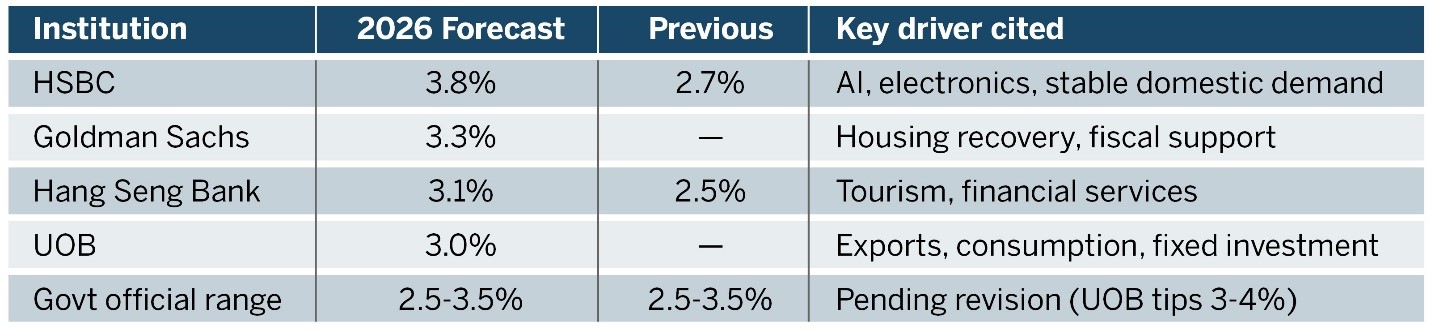
Sources: HKSAR government, HSBC Global Investment Research, UOB Group, Hang Seng Bank Economic Research and agencies.
Chart by: Alex Tang.
China International Capital Corp (CICC) identified investment as the primary driver, up 17.7 percent year-on-year, with strong private consumption and external demand providing additional support.
READ MORE: HK economy posts strongest growth in almost five years
But analysts cautioned that several headwinds could temper the city's growth trajectory in the months ahead. The Middle East conflict, which disrupted Strait of Hormuz shipping lanes and pushed up global energy prices, has yet to fully feed through to Hong Kong's trade and logistics data, with lagging cost pressures expected to weigh on second-quarter export figures.
The consensus has shifted decisively above the government's current official range, reflecting growing conviction that Hong Kong's economic transformation — anchored in AI-related trade, capital markets activity, and a recovering property market — is proving more durable than was previously assumed.
