

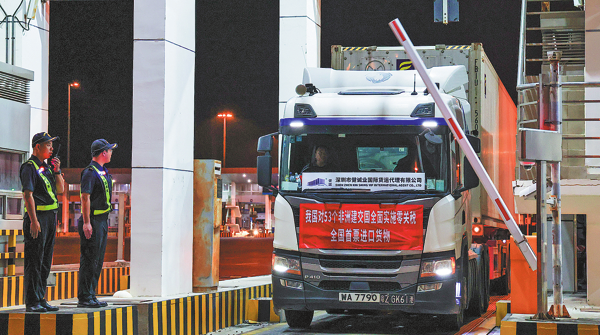
In the early hours of Friday, a truck carrying 24 metric tons of fresh apples from South Africa swiftly cleared customs at Shenzhen Bay Port — Asia's largest land port handling both passenger and cargo traffic — becoming the first shipment to enter China as a new zero-tariff policy covering 53 African countries took effect.
China is the world's first major economy offering such unilateral, full-coverage zero-tariff treatment to all its African diplomatic partners. The nation will continue to sign agreements on economic partnerships for shared development and expand access for African products through upgraded "green lanes" and other trade facilitation measures.
Companies handling African imports are already feeling the change. "The zero-tariff measure is a real benefit for us," said Luo Shengcong, general manager of Shenzhen Kin Shing Yip International Agent Co, a trade logistics company.
Under the previous rules, similar apples imported from South Africa were subject to China's most-favored-nation tariff rate of 10 percent. With the duty now down to zero, the current shipment alone will save about 20,000 yuan ($2,929), Luo said.
RELATED ARTICLES
- Zero-tariff for African nations with diplomatic ties with China
- Xi vows to work for Africa’s well-being
- China, Africa share harvest of strong ties
The zero-tariff policy aligns with China's broader opening-up agenda. During talks with visiting Mozambican President Daniel Chapo in April in Beijing, the Chinese president said that China "has always accorded special priority to Africa in the course of steadily expanding its high-standard opening-up".
This year marks the 70th anniversary of the start of diplomatic relations between China and African countries. African diplomats in Beijing said the zero-tariff policy has added fresh momentum to mutually beneficial Sino-African cooperation.
Hodan Osman, Somalia's ambassador to China, said the policy has opened a strong new phase for Africa-China trade by helping more African products reach Chinese consumers and by attracting investment into production, packaging and export capacity.
Somalia's seafood is among the products with strong export potential, given the country's long coastline on the African mainland and annual seafood output of up to 800,000 metric tons.
China's vast market could encourage African producers to raise their output and improve export conditions, Osman said.
Harry Zevon, Ghana's deputy head of mission in China, described the policy as "quite generous, considering its coverage of 53 countries", noting that the measure further reflects China's interest in the development of Africa and its willingness to share its own development opportunities.
He said the policy could also benefit Ghana's industrialization drive under its "24-Hour Economy Initiative", which aims to process more agricultural products and minerals for domestic and overseas markets.
At a time when some countries are raising tariffs and turning to protectionism, China is sending "the opposite message", Zevon said, calling the measure both a strong form of diplomacy and a smart approach to relations with Africa.
Fredrick P. Malire, a counselor at the Malawian embassy in China, said the policy gives Africa "a great opportunity" to narrow the trade imbalance between the two sides. Malawi, with its strong agricultural base, sees potential in China for products such as soybeans, groundnuts and macadamia nuts, he added.
The diplomats' comments came against the backdrop of a fast-expanding Sino-African trade relationship. China has remained Africa's largest trading partner for 17 consecutive years. Official data shows that in the first quarter of 2026, China-Africa trade increased 23.7 percent year-on-year, with China's imports from Africa up 14.6 percent and exports to the continent up 29 percent.
Lin Jian, a spokesman for China's Foreign Ministry, earlier described the zero-tariff policy as "a golden key to trade prosperity, a propeller to industrial investment, a timely response to challenges, and a bridge connecting the hearts of Chinese and African people".
Against the backdrop of rising protectionism, unilateralism and spillovers from the Middle East situation, Lin said that China is using the zero-tariff measure to bring greater stability to China-Africa ties, thereby contributing to global peace and development.
Susan Mukami, a project coordinator at China Media Group Africa, wrote in Kenyan newspaper Business Daily that gaining access to China's vast consumer market is "not a small thing" for Kenya, and she compared it to being invited to "the biggest buffet in the global economy" without paying an entry fee.
China's messages to Africa are clear — "we are partners", "we respect your sovereignty" and there are "no political conditions", Mukami said.
