

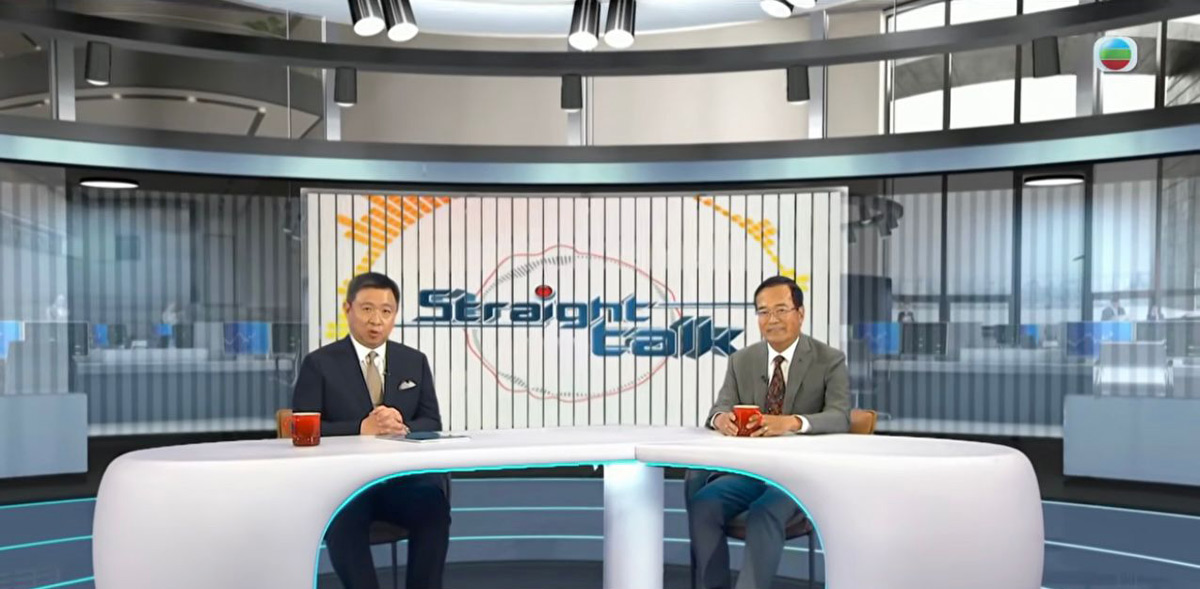
Towngas Managing Director Peter Wong is on the show to talk about how Hong Kong is navigating the global energy crisis and will grow in the future, after 164 years of serving the city, the Guangdong-Hong Kong-Macao Greater Bay Area, and other Greater China regions and other parts of the world.
Check out the full transcript of TVB’s Straight Talk host Eugene Chan Kin-keung’s interview of Peter Wong:
Chan: Welcome to Straight Talk! I'm Eugene Chan. With us is Peter Wong, the managing director of Towngas. Wong joined Towngas in 1997, initially as financial controller and has served as managing director from the year 2022. He has twice been recognized by Forbes as one of “The Best CEOs of Chinese Listed Companies” and brings more than 47 years of experience in corporate finance, management and international business. This evening, he shares with us his perspectives on how Hong Kong is navigating the global energy crisis. Peter, welcome to the show for the first time!
Wong: Thank you for having me here.
Background
Chan: Right, Peter, before we start to ask more specifically about the energy crisis, we know that Towngas has been sort of fueling Hong Kong since 1862. And I know that it will be your 165 years anniversary coming up. So, maybe you can tell the viewers what exactly does Towngas do? Because most people will see it as a traditional gas supplier, but I think you do more than that. Maybe you can tell the viewers what your company is aiming to do and what you have achieved so far.
Wong: Yes, you're right. Hong Kong and China Gas established in the year 1862, 164 years ago. And for a long time, we've been serving the Hong Kong communities supplying Towngas. Interestingly, the composition of Towngas is 50 percent hydrogen. Hydrogen is now a hot topic for energy experts. So, we will find a way to serve the Hong Kong communities with more energy. Other than Towngas, maybe hydrogen, if there's a need.
Chan: Right.
Wong: Yes, we've been a utility, Hong Kong gas utility company for a long time. But starting from the year 1994, the senior management at that time looked forward into Hong Kong situation. They foresaw that Hong Kong situation was saturated. In fact, it is really saturated with 2 million household customers. And the increase is very marginal, only 10,000 or maximum 20,000 residential additional customers. And then in the year 1994, the management at that time looked around and see where we can expand our utility business. And they have been to other places, other countries. But at the end of the day, the background is so nice. Our backyard is so nice. So they started looking into China. Since then, we developed the Citygas China business for the past 31 years. Initially, we only have two Citygas in Guangdong province. Now we have 320 Citygas in China, in the Chinese mainland, serving 45 million household customers. Hong Kong just only 2 million household customers.
Chan: Right, so that means the China business becomes quite a significant sort of in terms of revenue for the company.
Wong: Yes, exactly.
Chan: Right, Peter, I know that as we introduced to the viewers, you have like 47 years of good business experience. And given the current market now, when you just mentioned, you have quite a saturated market. Our population isn't growing as quickly as before. Look Hong Kong is facing a lot of challenges with people trying to spend money, maybe traveling overseas. Look at the Easter Holidays we has just seen. How do you continue to maintain this momentum or sustainability for a company? Because all your shareholders are very interested to know the company must continue to grow and grow in the right direction. Especially, you know that the whole world is growing green. That sort of transformation, it's going to be very costly as well. So, how do you balance growth and also meaning good profit for the company?
Wong: Being senior executive of a company, we have to take a longer view of what additional business can help the company grow. And so from Citygas, Hong Kong, and then we expand into China. And then even we have water business in the mainland. People always say, “How come water and fire? We suppose they don't go hand in hand”, right? And in fact, when we look at the water business, there's a lot of synergies. For example, in the city, we are serving Citygas. The residents, they use water for sure. Same customers. And then when we lay the pipelines for gas, we can at the same time lay the pipeline for water as well. Of course, not one single pipeline to serve water and gas. They have to be separate. But then that will save a lot of money and cause less inconvenience to the local residents. So, there are a lot of synergy when you open up your eyes and look around and the opportunities are always there.
Market volatility and oil prices
Chan: Right. Peter, let's move on to the topic that we want to know, especially the viewers who will be very interested. Because if you look at the bigger picture now, I will use the word messy at the moment. The tension between the East and the West has been squeezing the supply chains, not to mention the US-Iran war. They're causing global energy market and the shipping routes all been disrupted. And I just read that the CLP Power Chairman Mike Kadoorie says Hong Kong is on yellow alert. Would you agree with him?
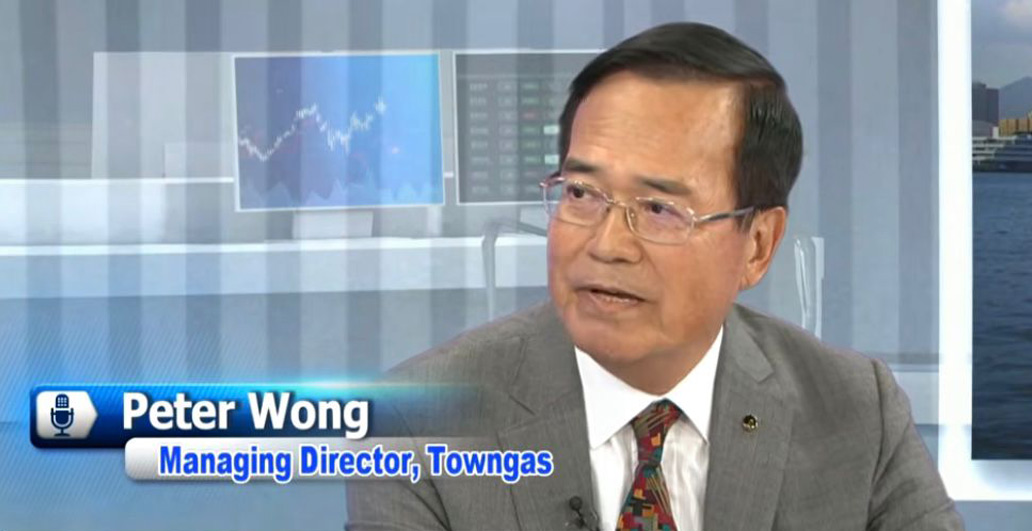
Wong: Yes, yes. It is quite sad to look at the current situation as we are living in a chaotic and unpredictable world. And I hope people, and create a lot of conflicts. I hope people will bear in mind that self-control is a gift for all conflicts. And when we want to see the world a better place, a better world for we all live in and love. But what's happening is we can't do much on that. And we, in Hong Kong and China Gas, we always keep an eye monitoring the situation hour by hour as the day goes by. And luckily, when we manufacture Towngas, we need two feedstocks. One is naphtha, the other is natural gas. And luckily, both of these feedstocks come not from Middle East. Naphtha, we source naphtha from Malaysia, Indonesia, Singapore, etc. And natural gas is a long-term contract with a supply in Australia. The contract was signed in the year 2006.
Chan: 20 years ago.
Wong: Exactly. It is 25 year long-term contract. And it is a take-or-pay contract. What does that mean? Take-or-pay means we have to buy a certain quantity of natural gas and the seller has to supply that quantity to us. It's confirmed. It's a contract for 25 years. And the price was basically determined in the year 2006. And you can imagine the price at that time much lower than today. So, we are pretty safe on that. Now, one thing I want to let you know that had we not signed that contract with the Australian gas supplier, customers in Hong Kong would have to pay HK$20 billion more during this 20-year period.
Chan: Right.
Wong: Because before that, we used 100 percent naphtha. Now we use 40 percent naphtha and 60 percent natural gas and save Hong Kong customers a lot of money.
Chan: So, in other words, although the Middle East war is still going on, despite the talks they're trying, at this stage, no deal has been reached, would you say that Hong Kong doesn't have to worry at all?
Wong: I can't. Well, it depends how long this war prolongs and how long this conflict will last. And for the next three to five months, I can ensure Hong Kong customers pretty safe, because we have the naphtha inventory on the site in our Tai Po plant at least two months. And then we already place order for the next two months. And the order is confirmed.
Chan: Right.
Wong: And natural gas, we don't have to worry about that because it comes from Australia by ship to Shenzhen and then use the submarine pipeline to our Tai Po plant to manufacture Towngas.
Chan: Right, so as long as it doesn't prolong forever, nor nothing happens in this part of the world, I think Hong Kong residents should be assured that at least under your directions, I think Hong Kong is quite safe in terms of energy supply.
Wong: Well, I can say for a short period of time, four months.
HK role in the energy transition
Chan: Right. Let's talk about a bit further on. I mean, as you know, Hong Kong has always been a part of China. And we have the 15th Five-Year Plan just been released. How do you see the energy security and also green transition that sort of being at the center of the plan? What does that mean for Hong Kong's energy's future?
Wong: It means a lot. Back to the year 2020, China made a commitment by the year 2030, carbon peak, 2060, carbon neutral. That strategy will continue and will not change. And now if you look back for the past five years or so, and then it's a very, very good strategy. I tell you why, because 50 percent of China's energy is imported. And the central government makes it very clear, in the long run, energy will be under its own hand. That makes sense. If you look at what happened, what is that?
Chan: Look at Europe and all that …
Wong: Exactly, in Ukraine or even in the Middle East, and then no energy. That means no life. You can't live, basically. So, the 15th Five-Year Plan basically highlights even strategy more on the renewable energy. Renewable energy is hydrogen, green methanol, sustainable aviation fuel, and ammonia, etc.
Chan: Right.
Wong: All of these basically will be in China's own hand. Energy will be safer in coming years.
Chan: Right, I see. So, Peter?
Wong: Yes. And that's, well, what about Hong Kong? Hong Kong will have natural gas will continue from not from the Middle East, it will be from Australia, or even in the long run, maybe from China.
Chan: I see.
Wong: So, we should be safe on that one.
Chan: Okay, time for a short break now, and we'll come back with more Straight Talk.
Chan: We are back on Straight Talk with Peter Wong, the managing director of Towngas, and we have been talking about how Hong Kong is navigating the global energy crisis. So, Peter, I think the viewers should be quite assured now that because of good planning ahead, Hong Kong is safe as long as the war doesn't get too prolonged or it stays in the Middle East and Hong Kong is quite safe in terms of energy.
Wong: Yes.
Chan: You also talk about the bigger picture that Hong Kong is actually moving along with the central government's plan to peak of carbon level in 2030 and neutrality in 2060. Where is currently Hong Kong in that sort of transition? I mean, as you know, energy transition often increase the cost as well. How do you balance affordability with sustainability? I often have to ask you that because you're in business for so long, you can assure our viewers.
Wong: The 25-year long-term contract is already a very good example that our Hong Kong customers, they don't need to worry about the natural gas, which is one of the feedstock to manufacture Towngas. And looking years ahead and also to consider the sustainability, and we try to green the feedstock. Even though right now, Towngas’ carbon dioxide emission only accounts for Hong Kong total 5 percent. The two electricity companies, for some reason, because they use coal and other energy elements, account for approximately 60 percent. And then the road transportation, the other 20 percent. But looking years ahead, we shouldn't sit comfortably on that one because the two-year electricity companies they will use more natural gas. And then their carbon dioxide emission will be coming down. And ours, if we don't do anything, it will be edging up, right? So, we've been looking at various ways to green the feedstock. Naphtha is … there are so many ways to green the feedstock. One thing is we can also even think of bringing in hydrogen, green hydrogen, whereas our R&D team is working on it to make sure that we will achieve the sustainability target set by the HKSAR government and also the central government.
Chan: Right, Peter, before we go to the hydrogen, I want to ask you more about the green methanol that you mentioned. Yeah, I've read that Towngas using waste tires to make green fuels in Inner Mongolia. And you call that greener methanol as a part of clean energy portfolio. It's quite an interesting concept. So, why is it called green methanol and how is it different from the regular methanol and how does it matter to Hong Kong?
Wong: Okay.
Chan: It's Inner Mongolia. It's a long way.
Wong: Okay. Now, very simple, not going into technical terms. If something is waste, but you can make it useful, turn it into good material for you to continue to use it; that is green. Very simple. You just think about that. Don't think about all these technical terms and what element you have to add. So long as it's waste, but I can make the full use of it and turn it into useful material. That is green already. The green methanol we just mentioned, yes, we have a plant in Inner Mongolia for quite some time. And in the past, that plant, we try to produce some chemical elements. And our R&D team, five years ago, and they came up with an idea of use the waste tires. In Inner Mongolia, one thing is there, there are so many heavy trucks.
Chan: I see.
Wong: Inner Mongolia is very famous for coal mines. The coal, when they dig out, and then they have to truck it to other places. So, many heavy-duty trucks. And then these tires will have to be replaced. So, in Inner Mongolia, there are tons, tons of waste tires. And our R&D team, they look at it and how can we turn this waste into green, as I mentioned earlier. So, we are successful in doing that. And even we got the EU certification as green methanol.
Chan: Right. How long have you been using this green methanol method in moving ahead?
Wong: Now, we will continue to use the waste, which is the waste tires in Inner Mongolia. And also, we are also looking at other ways in agriculture. Inner Mongolia, there are so many plant trees, and then this will become another element, make useful materials for us to manufacture green methanol. Now, we have set up another joint venture in Foshan. In Foshan, which is close to Hong Kong. And we are going to build another plant in Foshan to supply green methanol to Hong Kong, which is close. We want to keep Hong Kong still a big logistic hub for marine.
Chan: I see.
Wong: Without the green methanol, when other countries, they have the mandate that you have to use green methanol, if we, Hong Kong, we don't have that supply, we may be facing some difficulties in competing with other ports.
Chan: Peter, I'm sure the viewers now would want me to ask you this question, because Towngas is smart enough to make use of wasted tires. That means the cost will be relatively low. Does that mean that the share price will continue to do well because of your profit margin is guaranteed? I'm sure they are going to ask you that question.
Wong: But I can't answer right now. I hope that our shareholders and stakeholders and everybody, our customers in Hong Kong feel a bit … Looking at Towngas, we have been serving the customers very well and the service and safety supply of gas are the priority on our list.
New energy
Chan: Right. I'm not going to push you any further. Viewers will make your own decision, right? Anyway, let's talk about hydrogen. Someone said that it's described as a fuel of the future and looks like Towngas has had its head-start already. So, how do you see the biggest challenge in the way forward? We all want green air, greener energy. And how do you, what will be the technical challenges in terms of moving ahead? Is it technical or economic?
Wong: Okay. Now, you're right. Everybody now is talking about hydrogen, in particular green hydrogen. Green hydrogen is not available just you can pick it up from the air or under the ground. You have to manufacture it. You have to manufacture green hydrogen using solar renewable energies. In order to produce huge volume to reduce the cost, then you have to look for big area and where the sunshine or the wind can afford to for this renewable energy to produce green hydrogen. And then you have to transport it. So, the cost right now, I can say is quite high, but I strongly believe that as time goes by and technology, so many smart people, so many experts, they will lower the cost. They will find a way to lower it. And Hong Kong, in Hong Kong situation, we are in a very unique position. Inside the pipeline, the gas we've been burning every day in our kitchen, 50 percent of which is hydrogen. That means we can easily suck the hydrogen out from the pipeline, which is safe and convenient, and then there will be an opportunity for us to explore these business opportunities.
Chan: Right, Peter, I think if the viewers are going to start thinking about energy usage, I know the cars and shipping companies are desperate for green energies, but the most important one I'm sure people will realize are talking about airlines. I mean, both Cathay Pacific and Hong Kong Express are cutting some flights due to high-jet fuel prices increases. So, there's talk about Sustainable Aviation Fuel (SAF) as a potential game changer. Are you looking at producing or supplying this sort of next generation fuels?
Wong: In fact, we have two plants. One is Jiangsu province in Zhangjiagang. The other plant just finished last year in Malaysia, in Johor, very close to Singapore. And these two plants can supply 770,000 tons a year. We are, as I understand it, we are the second largest supplier of SAF in the world. Similar to e-methanol, Hong Kong is a very important aviation hub. If Hong Kong, and in fact there are some other countries already they have a mandate, next year at 2 percent of SAF and even EU, they have a very clear mandate by the year 2030 then you have the SAF percentage will increase up to 10 percent. So, we've been talking to Hong Kong SAR government and also to aviation authority and airlines serving Hong Kong that they are aware of this and we're working on it and detail will be announced soon.
Way forward
Chan: Right Peter, we have less than 30 seconds. I'm going to ask you the last question. As Hong Kong is very closely integrated with the GBA and especially Towngas has this wonderful experience with the mainland for all the past decades. Do you see this integration give Hong Kong more opportunities and also with all the geographical uncertainty, is it confident to say Hong Kong is safe for energy in the future?
Wong: Yeah, Hong Kong is one of GBA cities. The closer connection with the other cities in the GBA is just only better for Hong Kong. Hong Kong is a stepping stone for all these Chinese companies in the GBA if they want to go out because Hong Kong has been enjoying the status of being an international city. So, foreign countries they view Hong Kong as very important as their stepping stone into China as well.
Chan: Okay. So, Hong Kong is very promising in coming years. Thank you Peter for sharing your insights with us.
The current energy challenges are sending a warning signal and light to Hong Kong. How we respond now will shape not just our economy but our environment and our resilience as a city. We cannot afford to be reactive. We must continue to think ahead. Have a good evening and see you next week.
