

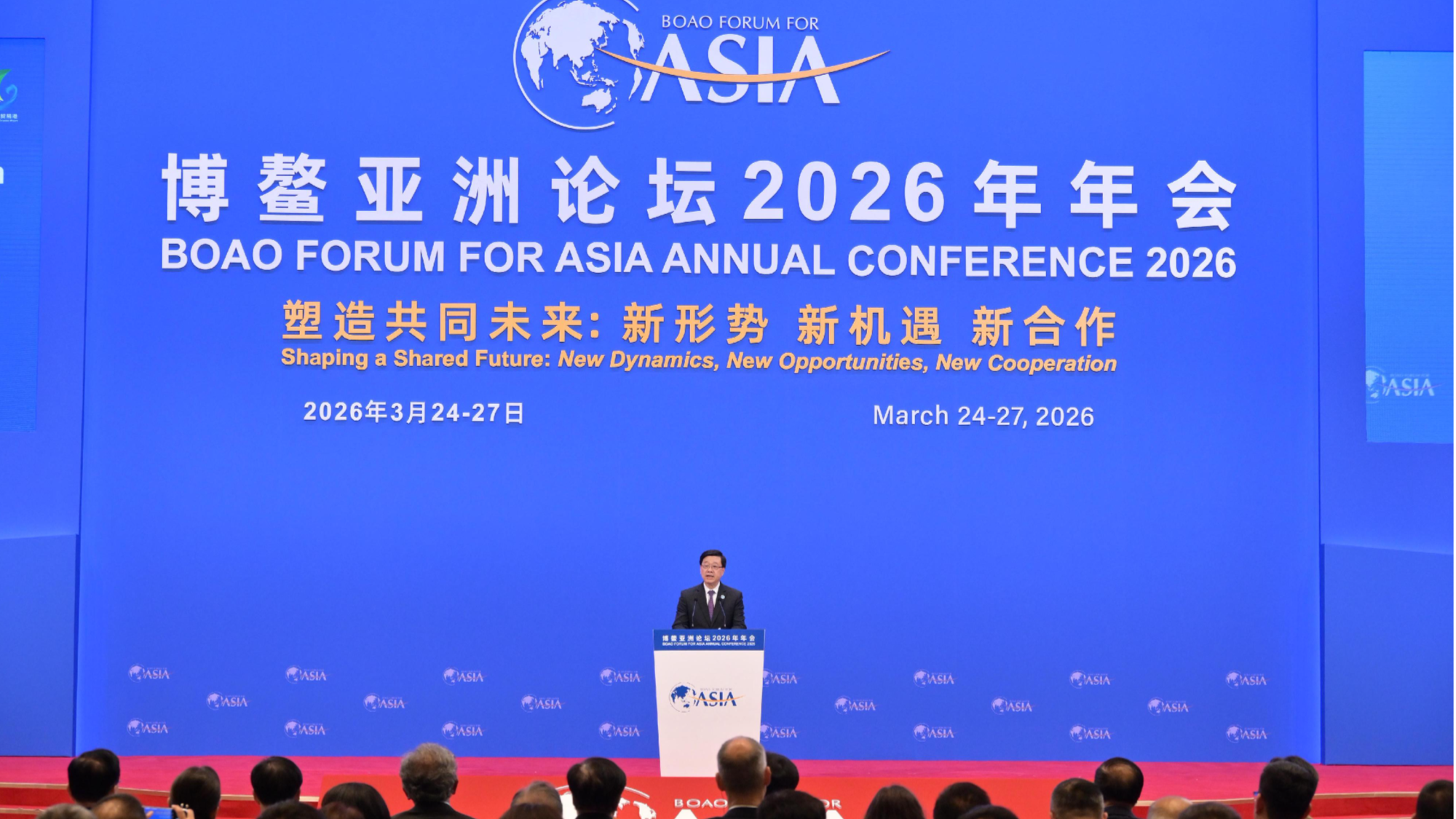
Hong Kong is prioritizing forging more free trade pacts and remains firmly committed to joining the Regional Comprehensive Economic Partnership (RCEP) soon, Chief Executive John Lee Ka-chiu said on Tuesday, underscoring the special administrative region’s aspirations in driving regional economic integration.
“We maintain close communication with the RCEP’s member economies, and will continue to rally their support for Hong Kong’s early accession,” Lee said in his speech at the Global Free Trade Ports Development Forum, a high-profile event held on the sidelines of the Boao Forum for Asia (BFA) Annual Conference 2026.
The four-day BFA conference opened earlier in the day in Boao, a picturesque coastal town in Hainan province, bringing together about 2,000 participants from more than 60 countries and regions to explore new opportunities for growth and cooperation.
During the forum, the HKSAR leader said, “no economy can thrive in isolation”, stressing the need to uphold openness and inclusiveness in multilateral trade amid mounting geopolitical tensions and protectionism.
As a free port for more than a century, Hong Kong has long championed free and unfettered trade, and is looking to further expand its global trade network, Lee said. “At a time when some are drawing battle lines, Hong Kong is drawing trade routes. We choose connection over confrontation, and we value cooperation over conflict.”
He said Hong Kong has signed free trade agreements with 21 economies and investment agreements with 33 economies, adding that the SAR recently concluded investment agreement negotiations with Qatar, Bangladesh and Peru. Talks on new investment pacts with Saudi Arabia and Egypt are also in progress, according to Lee.
He pledged that the SAR will spare no effort in supporting the country’s hosting of the Asia-Pacific Economic Cooperation meetings this year, with Hong Kong set to hold the APEC Finance Ministers’ Meeting in October.
The forum also highlighted the latest progress in developing Hainan’s Free Trade Port (FTP), a major policy breakthrough for China last year. The Hainan FTP has implemented island-wide independent customs operations since Dec 18, expanding its list of zero-tariff goods to more than 6,600 categories — about 74 percent of the total.
Lee said he is confident that the free trade ports of Hainan and Hong Kong can complement each other and together build a powerful engine for global free trade.
Jonathan Choi Koon-shum, chairman of the Chinese General Chamber of Commerce in Hong Kong and a panelist at the forum, described the prospects of Hong Kong-Hainan cooperation as “very promising”.
“The relationship between the two places is one of cooperation, not competition,” Choi said. He suggested authorities open the door for enterprises in the Hainan FTP to adopt Hong Kong’s common law in their operations — a model already applied in certain areas in Shenzhen and Zhuhai — so as to foster a more conducive business environment.
Choi also called for a more open data flow between Hainan and Hong Kong, which he believes could help the latter advance its artificial intelligence industry.
“Since electricity costs are lower in Hainan, data and computing centers could be built there to transmit data and computing power to Hong Kong,” he said, adding, “This would spare Hong Kong from building its own expensive computing centers, and allow Hong Kong to purchase affordable computing services from Hainan through the FTP.”
Also speaking at the event, Cao Yuanzheng, a visiting professor at the School of Economics and Management, Tsinghua University, said the Guangdong-Hong Kong-Macao Greater Bay Area has manufacturing strengths and Hong Kong has financial strengths, while Hainan can serve as an institutional platform.
“If Association of Southeast Asian Nations countries and those involved in the Belt and Road Initiatives leverage this platform, industrial chains will naturally evolve into a circular ecosystem,” he said.
Cao noted that deeper financial cooperation between Hong Kong and Hainan will be key, adding: “We believe the internationalization of the renminbi can draw on Hainan’s special policy arrangements to link with Hong Kong’s renminbi market and better serve ASEAN countries. This direction is worth exploring.”
Contact the writer at gabylin@chinadailyhk.com
