

BEIJING - City super leagues are transforming football in China, turning regionally rooted local matches into nationwide phenomena.
During the ongoing fourth session of the 14th National People's Congress (NPC) and the fourth session of the 14th National Committee of the Chinese People's Political Consultative Conference (CPPCC), the leagues emerged as a hot topic as national lawmakers and political advisers examined how city super leagues have grown from a small spark into a nationwide craze and their impact on public interest, the economy and regional development.
Passion unleashed
"Everyone agrees that the success of 'Su Super League' comes from many factors, but most importantly, it captured the hearts of the people and drew them in," said multiple NPC deputies from the Jiangsu delegation.
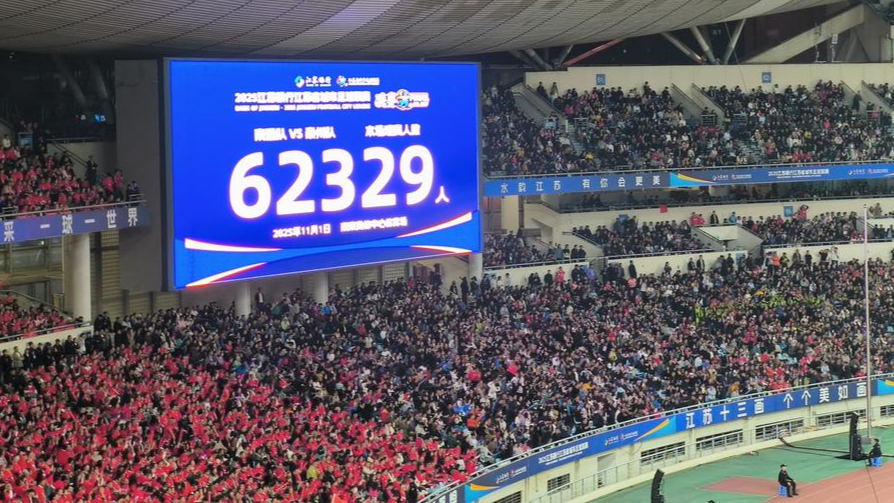
In 2025, the league ran for nearly six months, drawing more than 2.43 million spectators across 176 days, averaging 28,000 per game, with the final setting a record of 62,329 fans.
Shui Qingxia, an NPC deputy and former head coach of China's women's national football team, shared her experience at the matches.
"I queued for pancakes, grabbed souvenirs, and fully soaked in the fan culture," she said. "People come not just for the score but for the atmosphere, enjoying it as an experience and a way of life."
Its success has inspired other regional competitions, with Jiangxi, Hunan, Inner Mongolia and other regions launching their own leagues, creating wave after wave of grassroots football excitement.
Xu Shixiao, an NPC deputy and Olympic canoeing gold medalist from Jiangxi, has been following her province's league.
"People from all walks of life running, shouting, and laughing on the pitch. You can feel that energy even through a screen. It is like Jiangxi spice, intense and invigorating," Xu said.
As she put it, factory workers, students, firefighters and delivery couriers can all find a place on the pitch. Liaoning freestyle skier Wang Xindi, who won gold in men's aerials at the Milan-Cortina Winter Olympics, has also joined a team and plans to train with them in late March.
"I'm very grateful to the platform for giving football fans a chance to take part," Wang said.
Economic engine
During the Su Super League, a ticket priced at just 5 to 20 yuan (about $0.72 to $2.89) became a catalyst for spending.
Wang Chengbin, a member of the CPPCC and head of Jiangsu's Social Science Association, said last year's Su Super League boom helped drive consumption. During the season, nighttime cultural and tourism zones set up as secondary viewing sites generated over 21 billion yuan (about $3 billion).
As city super leagues expand nationwide, they are driving demand in venue construction, sports equipment, event operations and training services.
Wang Qiangzhong, an NPC deputy and chairman of Jiangsu Baisite Group, reported that enterprise revenue rose by more than 660 million yuan (about $96.0 million) in 2025, driven largely by venue construction and fitness facility upgrades.
"Every league brings new business opportunities," said Chen Ailin, an NPC deputy and mayor of Yongzhou, Hunan. "Local farm products that once struggled to sell are now in demand, while side viewing venues have drawn crowds to shopping districts and boosted the night economy."
"A well-run city super league is like an economic engine. Its impact goes far beyond ticket sales and reaches many parts of the economy," Shui added.
The league's economic potential is far from exhausted. The new Su Super League season has attracted 24 prominent corporate sponsors, while an open lottery for 32 small-business sponsorship slots drew applications from more than 3,000 micro-enterprises.
"The success of the Su Super League shows the potential for sports to integrate with tourism and commerce on a large scale," said Zhang Yufei, an NPC deputy and Olympic gold medalist swimmer. "It's clear that service and cultural consumption are emerging as new engines of economic growth."
ALSO READ: Immersive Messi show illuminates a legendary soccer career
Reaching further
City super leagues also serve as a thread weaving through society, linking fans from different regions.
"Our league draws fans not only from locals but also from neighboring regions," Xu said. "Fans treat a ticket like a pass. They watch the match, visit historic kilns, climb mountains, turning football into an immersive travel experience."
This gathering fosters integration and enables broader regional collaboration for shared development.
The upcoming Northeast Super League has become a hot topic, organized by Liaoning, Jilin, Heilongjiang and Inner Mongolia in China's northeast, a traditional industrial region looking to revitalize its economy through sports.
"It has the potential to become a nationally recognized regional football brand and a high-quality sports IP, helping boost the region's economy," Liu Zheng, president of Shenyang Sport University and a CPPCC member, said.
"Leagues also foster ethnic exchange," Zhang Weidong, governor of Diqing Tibetan autonomous prefecture in Yunnan, said. "The matches bring together players of different ethnicities, cheering fans, and tourists enjoying local customs, strengthening community ties."
The momentum continues to grow, with the Xinjiang "Jiang Super League" set to debut in May, bringing a distinct local flavor.
NPC deputy Kenneth Fok Kai-kong proposed a sports IP for the Guangdong-Hong Kong-Macao Greater Bay Area.
"One city cannot support a major sports IP, but the Bay Area, with over 80 million people, can," he said. "Having hosted the National Games last year, we know how to run events like city super leagues."
Gao Zhidan, director of China's General Administration of Sport, concluded, "We will continue to tap the potential of the sports industry, optimize the structure, improve the supply chain, and cultivate talent so that the energy of sports translates into growing consumer markets.
