

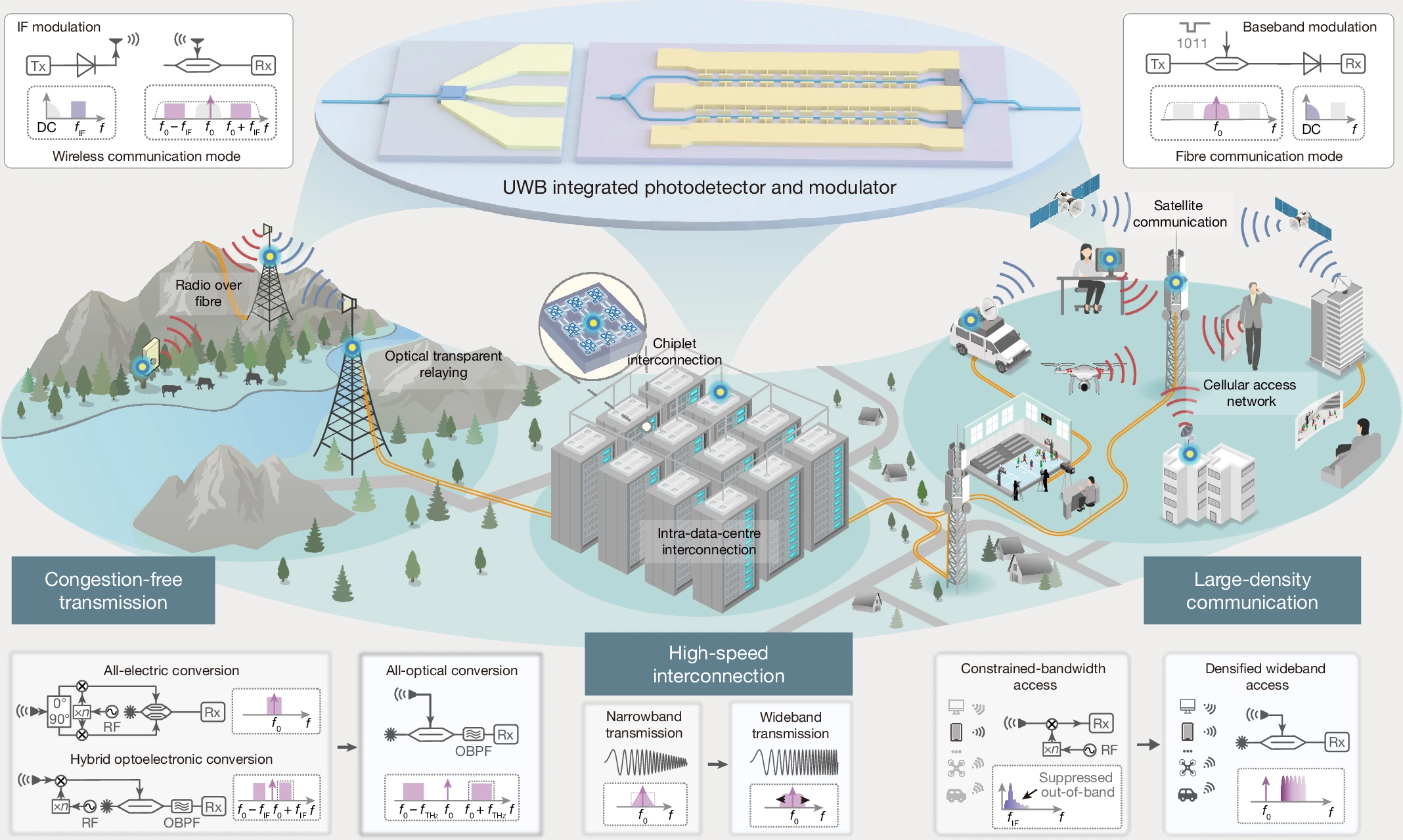
BEIJING -- A Chinese research team has developed an integrated communication system bridging optical fiber and wireless networks, setting a new world record for data transmission speed, according to a study published Thursday in the journal Nature.
The increasing demand for computing power in AI data centers and the development of next-generation 6G wireless networks require high-speed, low-latency signal transmission across diverse scenarios.
ALSO READ: Chinese scientists achieve major breakthrough in scalable quantum networks
However, differences in signal architecture and hardware between optical fiber and wireless communication systems have made it difficult to achieve high-speed, compatible end-to-end transmission between the two systems on the same infrastructure, posing a major challenge for high-speed telecommunications networks.
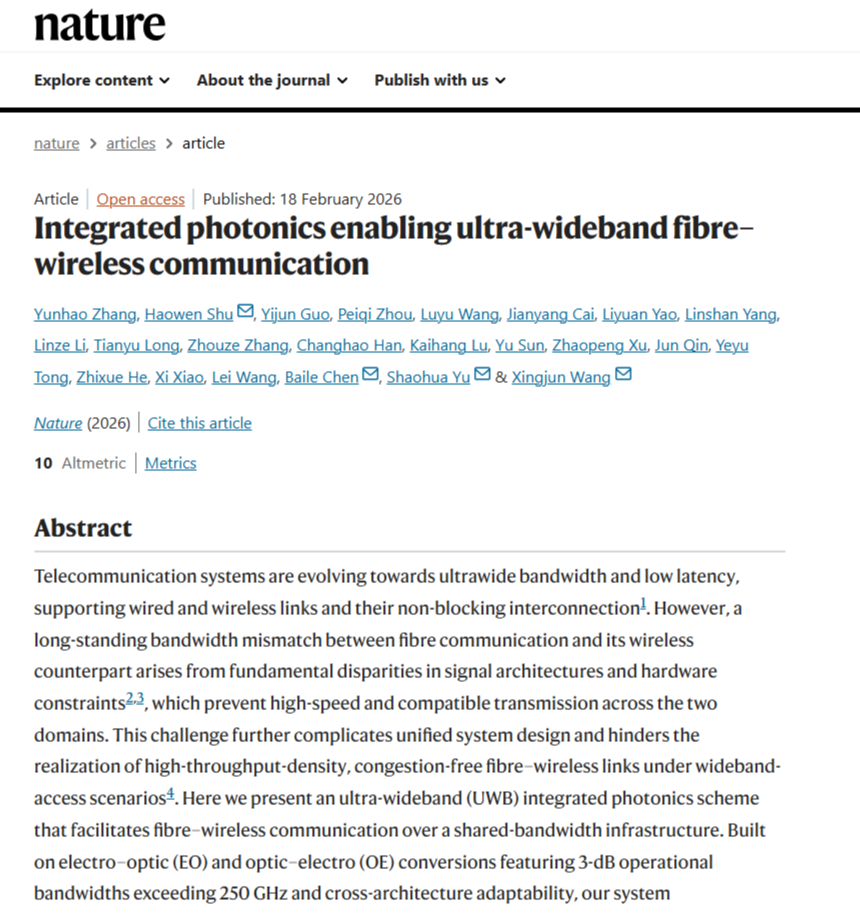
The research team, comprising Peking University, the Peng Cheng Laboratory, ShanghaiTech University, and the National Optoelectronics Innovation Center, has developed a converged communication system that achieves single-channel signal transmission of 512 Gbps over optical fiber and 400 Gbps over wireless.
According to Wang Xingjun, one of the paper's corresponding authors at Peking University, the new system supports dual-mode transmission via both optical fiber and wireless networks, not only avoiding bandwidth limitations and noise accumulation but also enhancing anti-interference capabilities.
READ MORE: Chinese scientists identify core pathological brain network underlying Parkinson's disease
The team also simulated a large-scale 6G user access scenario, demonstrating multichannel real-time 8K video access across 86 channels, achieving a transmission bandwidth more than ten times that of the current 5G standard.
Beyond enabling ultra-large-capacity communication, the system exhibits excellent performance in terms of energy consumption, cost and scalability for large-scale deployment. The system's all-optical architecture enables seamless integration with existing optical networks, fostering deep convergence between mobile access networks and optical fiber networks.
READ MORE: Chinese scientists develop innovative molecule for precision cancer treatment
Wang noted that the new system has significant application potential in scenarios such as 6G base stations and wireless data centers and could reshape the architecture of telecommunication systems, laying the foundation for next-generation ultra-broadband, high-speed integrated fiber-wireless communication.
