

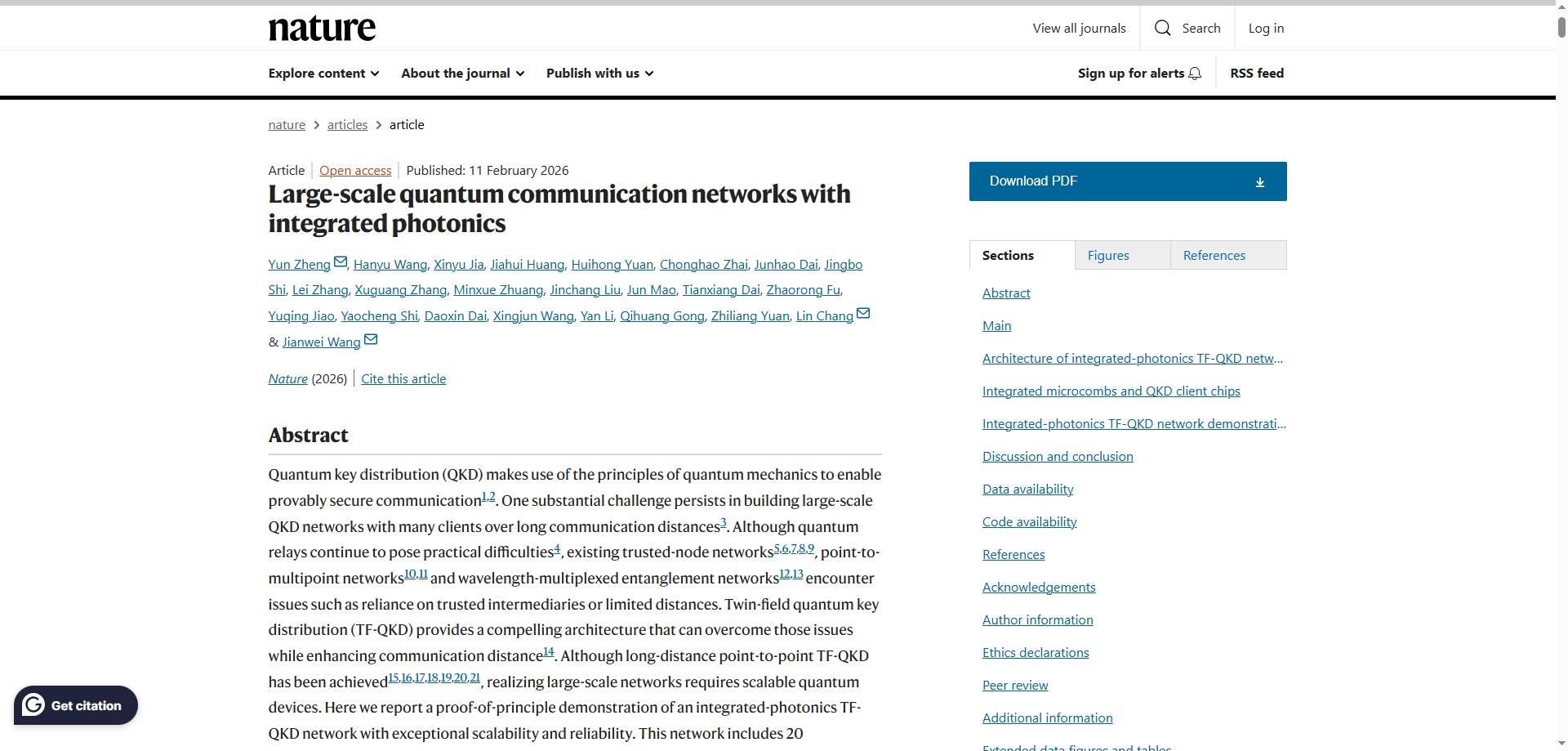
BEIJING -- Chinese researchers have developed the world's first large-scale quantum key distribution (QKD) network based on integrated photonic quantum chips, according to a study published on Thursday in the journal Nature.
This network supports parallel communication involving 20 users, while covering a total distance of 3,700 kilometers and achieving a global leading level in terms of both user scale and network span.
READ MORE: Chinese researchers score breakthrough in general AI logical reasoning
QKD uses quantum states to transmit keys for information encryption, thus ensuring communication security. Twin-field QKD, which is suitable for long-distance quantum communication and supports resource sharing at the detector end, has emerged as an advanced form of QKD technology.
However, due to the extremely high performance requirements of light sources and modulation devices, the necessary hardware chip integration is difficult to achieve. As a result, this technology is mostly used in point-to-point QKD, while the realization of a multi-user, large-scale network system faces considerable challenges.
ALSO READ: Chinese researchers develop self-powering pacemaker
A team led by Wang Jianwei from Peking University's School of Physics, and Gong Qihuang, academician of the Chinese Academy of Sciences, has developed a series of high-performance, fully integrated photonic quantum chips. On the basis of these chips, they constructed a twin-field QKD network comprising 20 quantum chip nodes.
According to Wang, this is the world's first demonstration of a QKD network based on photonic quantum chips in over two decades. Experiments showed these chips exhibit high uniformity during wafer-level fabrication, enabling low-cost mass production. It lays a technical foundation for building QKD networks featuring longer distances and more users.
READ MORE: Chinese researchers achieve progress in clinical trial of brain-computer interface
"Chip-based QKD networks represent a significant step toward system miniaturization and device practicality," Wang said, adding that high-performance and low-cost photonic quantum chips hold significant potential in advancing the practical application and large-scale deployment of quantum networks.
Reviewers from Nature noted that this work represents a significant advancement in quantum chip and quantum network technology, while the demonstrated quantum chip network exhibits remarkable scalability. "The article is undoubtedly of high impact for the quantum communication community," a reviewer commented.
Gong said this achievement provides a viable solution for constructing large-scale quantum communication chip networks and will promote the miniaturization, practical application and large-scale development of quantum communication systems.
