

Progress seen as hard work and investment of domestic firms beef up tech prowess
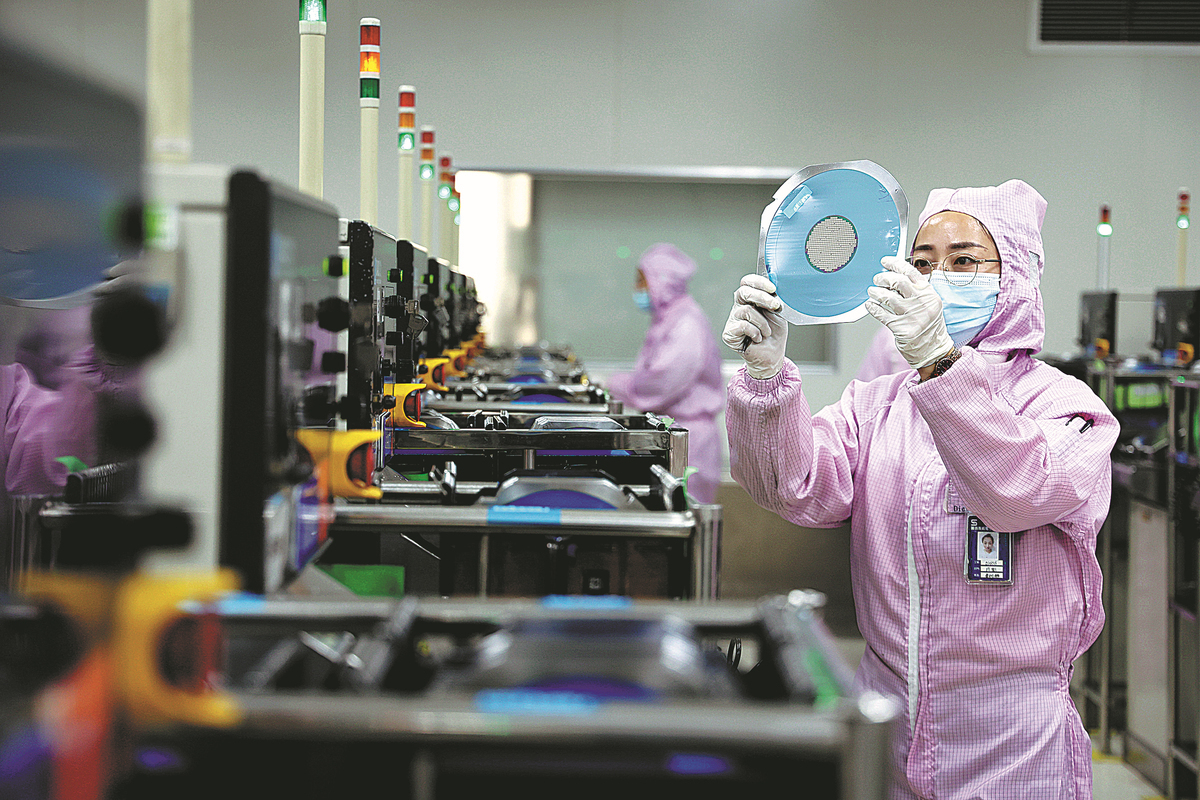
In a milestone for China’s semiconductor industry, three Chinese equipment manufacturers ranked among the world’s top 20 by sales for the first time in 2025, according to data from Japanese research firm Global Net.
This marks a rise from just one company in 2022, before stronger US government restrictions came in, underscoring China’s accelerated progress in bolstering the domestic supply chain.
The progress is an outcome of Chinese companies’ hard work and investment in beefing up technological prowess, but a gap still exists in core equipment such as lithography machines, and more efforts are needed to achieve breakthroughs, experts said.
The sales ranking reveals a climb for Naura Technology Group, which jumped from eighth place in 2022 to fifth in 2025. It now only trails global giants ASML, Applied Materials, Lam Research, and Tokyo Electron.
Founded in 2001, Naura has not yet disclosed its annual revenue for 2025, and Global Net based the ranking partly on estimated data. Financial services provider Suntime compiled forecasts from multiple securities companies to estimate Naura’s revenue to stand between 46.8 and 52 billion yuan ($6.74 billion-$7.49 billion) in 2025.
New to the list at 13th place is Advanced Micro-Fabrication Equipment Inc China, or AMEC, whose etching equipment comes close to the cutting edge.
In chip making, etching is the key process of selectively removing unwanted material layers from a silicon wafer to engrave precise 3D patterns, circuits, and transistor structures.
Shanghai Micro Electronics Equipment, specializing in lithography machines that “print” circuit patterns onto silicon wafers, secured the 20th position. While acknowledging generational gaps with market leader ASML, the Shanghai-based company’s presence highlights China’s domestic capability in this most critical and challenging segment.
Expanding the list to the top 30 would include two more Chinese companies — ACM Research and Hwatsing Technology.
This collective ascent is widely viewed as a direct response to United States-led export controls on advanced semiconductor technologies, which catalyzed China’s drive for greater self-sufficiency in chip-making tools.
Roger Sheng, vice-president of research at US market research company Gartner, said: “It’s fair to say that Chinese companies’ technological gap with international industry leaders is continuously narrowing. This progress has provided strong support for domestic chip manufacturers in their technological upgrades and production expansion efforts, even amid restrictions on access to US technology and equipment.”
The manufacturing of advanced chips involves over a thousand process steps, each requiring specialized equipment. Chinese suppliers can now cover equipment for almost every stage, including deposition, etching, and cleaning. This burgeoning ecosystem includes a wave of emerging startups, experts said.
“With the exception of lithography machines, these domestic tools are now being widely used in Chinese semiconductor factories. For instance, in etching, Naura has become a key equipment provider for production of a Chinese company’s advanced memory chips,” Sheng added.
Yin Zhiyao, chairman and general manager of AMEC, said at a meeting in May 2025 that the company’s product portfolio includes 30 percent of all the integrated circuit equipment categories, and it aims to collaborate with partners to offer 60 percent of all high-end IC equipment categories over the next five to 10 years.
Yin said that AMEC would soon complete the development of more than 20 types of thin-film equipment that are subject to international export restrictions on China, and aims to finish the development of nearly 40 thin film equipment by 2029.
Thin film equipment in chip making refers to specialized machinery used to deposit atomic-level layers of conductive, insulating, or semiconducting materials onto silicon wafers.
But a significant hurdle remains in the most advanced segment — lithography machines — where China still has years of work to do.
Contact the writers at masi@chinadaily.com.cn
