

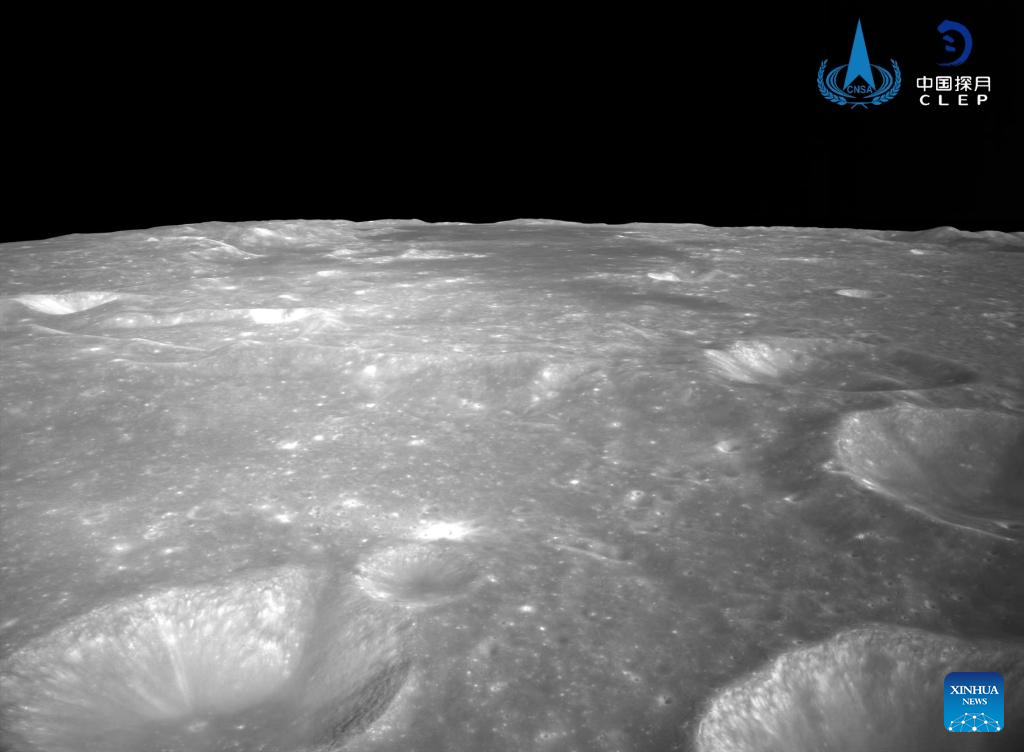
BEIJING - For the first time, scientists have confirmed that the impact cratering rates on the near and far sides of the moon are essentially consistent, laying a solid basis for the establishment of a globally unified lunar chronology system, according to the Science and Technology Daily.
A research team led by the Chinese Academy of Sciences' Institute of Geology and Geophysics successfully revised the decades-old lunar impact crater chronology model by analyzing remote sensing images.
Their study reveals a uniform impact flux across both hemispheres, provides evidence that early lunar impact events followed a smooth trend of gradual decline, rather than the dramatic fluctuations previously hypothesized. Their findings were published in Science Advances on Thursday.
ALSO READ: Chang'e-6 samples provide evidence suggesting global 'magma ocean' on early moon
Knowing the age of the lunar surface is crucial to understanding the moon's geological evolution. For decades, scientists have estimated the age of unsampled regions by counting impact craters, with a higher density indicating an older surface.
However, the existing crater chronology method relied entirely on samples from the near side of the moon, and the oldest specimens date back no more than 4 billion years. This limitation fueled ongoing debate about the moon's early impact history, including competing hypotheses such as the Late Heavy Bombardment.
A breakthrough came in June 2024, when China's Chang'e-6 mission returned 1,935 grams of lunar samples from the Apollo Basin, which is located within the South Pole-Aitken Basin on the moon's far side.
Analysis of these samples identified two key rock types: young basalt aged at 2.807 billion years old, and ancient norite formed 4.25 billion years ago.
READ MORE: Study: Lunar samples of Chang'e-5 aged 1.96 billion years
The norite, in particular, originated from magma that crystallized after the giant impact event that formed the South Pole-Aitken Basin -- the moon's largest and oldest impact structure. These samples have served as a critical anchor point in reconstructing the early history of the moon.
The researchers systematically mapped crater densities across the Chang'e-6 landing area and the broader South Pole-Aitken Basin using high-resolution remote sensing imagery.
By then integrating this new density data with all historical sample data from the Apollo, Luna and Chang'e-5 missions, they constructed a new, more comprehensive lunar impact chronology model.
Their results show that far-side crater density data aligns perfectly with the confidence interval of the near-side-derived model. "This indicates that the impact flux was homogeneous across the entire moon, providing a reliable basis for a unified global lunar chronology," said Yue Zongyu, the study's lead author and a researcher at the institute.
Yue noted that the study fundamentally advances our understanding of lunar impact history and underscores the pivotal scientific value of the Chang'e-6 samples. The refined chronology will serve as a more accurate reference not only for lunar study but also for the dating of surfaces of other planetary bodies in the solar system.
