

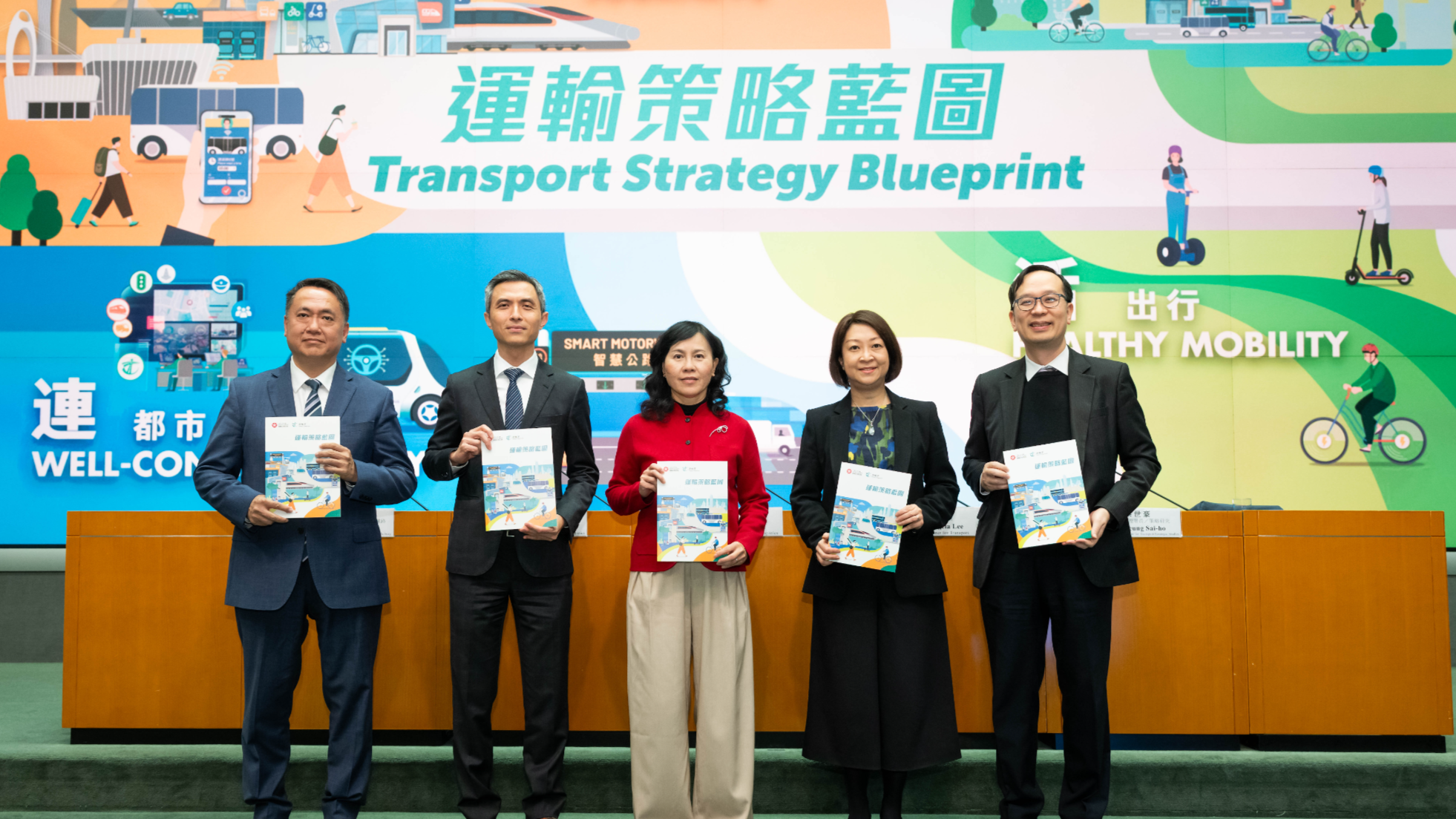
The Hong Kong Special Administrative Region government on Feb 6 unveiled a 124-page blueprint outlining local transportation infrastructure for the next two decades.
Titled “Transport Strategy Blueprint”, the overall aim is to streamline cross-boundary connectivity, enhance the traffic network, and boost smart mobility and parking facilities. The blueprint is structured around three core themes and proposes 25 recommendations under six major strategies.
One key focus is to facilitate cross-border vehicle operations. Secretary for Transport and Logistics Mable Chan said at a media conference that her bureau is actively promoting mutual recognition of commercial vehicle driving licenses in Hong Kong, Macao and the Chinese mainland.
Chan said the bureau aims to achieve concrete results this year and to implement the arrangement by 2027 after discussions with the mainland and Macao authorities.
Meanwhile, the “Southbound Travel for Guangdong Vehicles” initiative, which currently allows eligible vehicles from Guangzhou, Zhuhai, Jiangmen and Zhongshan to enter Hong Kong, will be gradually extended to other Guangdong cities within six months.
Chan said the authorities will monitor the rollout, public adaptation, and supporting facilities before considering further increases in quotas — currently set at 100 vehicles per day.
The government also plans to strengthen Hong Kong’s status as an international gateway by expanding transportation infrastructure. This includes fully opening the Route 6 highway — connecting Yau Ma Tei and Tseung Kwan O — within this year, and pushing ahead with a series of major railway and road projects as part of the nation’s extensive network layout. Studies will also be conducted on increasing cross-harbor traffic capacity.
The government will optimize land border crossings, including increasing the number of rail-connected boundary control points in the Northern Metropolis from two to six.
On the adoption of smart technology and green solutions, authorities plan to safely promote the large-scale development and commercial operation of autonomous vehicles. A dedicated task force will oversee pilot projects.
To develop the low-altitude economy, the government aims to formulate a development plan by year-end and work toward standardizing regulations in line with mainland and international standards.
The blueprint also includes strategies to advance the “Smart and Green Mass Transit System”, promoting its use in East Kowloon, Kai Tak, the Hung Shui Kiu/Ha Tsuen New Development Area, and the South Island Line (Western Section) project.
It also actively encourages public transportation operators to align with green transport policies by adopting new energy vehicles.
In addition, the government proposes to increase parking capacity. Over 12,000 new parking spaces are expected to be added this year. A new round of parking supply and demand studies will begin this year, with findings and recommendations to be released next year.
Ryan Ip Man-ki, vice-president and executive director of the Public Policy Institute at Our Hong Kong Foundation, said the government should adopt a more forward-looking perspective and actively leverage innovative technologies, such as extending autonomous driving to minibuses and buses.
He also suggested reviewing population flow trends across the entire Guangdong-Hong Kong-Macao Greater Bay Area to better streamline the region’s transportation network and enhance the overall transportation efficiency. For example, the authorities could consider extending the Hong Kong-Shenzhen Western Railway southward to connect with Hong Kong International Airport.
Kowloon Motor Bus (KMB), a leading franchised bus operator, said it supports the blueprint’s adherence to a public transportation-oriented policy, and pledged to utilize more smart technologies to effectively match bus resources with residents’ travel needs.
KMB aims to enhance synergies among various modes of transportation, offering residents diverse options for convenient travel.
Contact the writer at stacyshi@chinadailyhk.com
