

Editor's note: China Daily presents the series Friends Afar to tell the stories of people-to-people exchanges between China and other countries. Through the vivid narration of the people in the stories, readers can get a better understanding of a country that is boosting openness.
In September 2019, about four months before the outbreak of the COVID-19 pandemic, Thai college student Pitipat Thongkaew visited China for the first time. Little did then the 26-year-old know he would find a safe shelter in the country for the next three years during the pandemic. Moreover, the journey had given him another family.
"My grandfather is a Chinese who traveled from southern Guangdong province to Thailand at the age of around 20. Our family has kept lots of Chinese traditions, but family members at my age had never been to China, so I decided to study in China, where I have some blood ties," he said.
Pitipat began studying at Southwest China's Chongqing Technology and Business University. In a few months, he gained some basic knowledge of Mandarin, but then the global health crisis swept across the world.
"Almost all the foreign students in the university went back home after the pandemic outbreak. But I noticed the school and local government took rapid response, and the medical system's reaction also made me feel confident, so I decided to stay," Pitipat said.
Soon, he became the only foreign student in the dormitory building. During the most severe period, he remained indoors with free meals provided by the school.
"Any daily supply requirement was responded to quickly by teachers. And what moved me most was my Mandarin teacher, Yuan Yue, who kept talking to me every day to prevent me from suffering from depression," he recalled. "It was a unique experience, and I stayed safe in China both physically and mentally during the pandemic."
New family
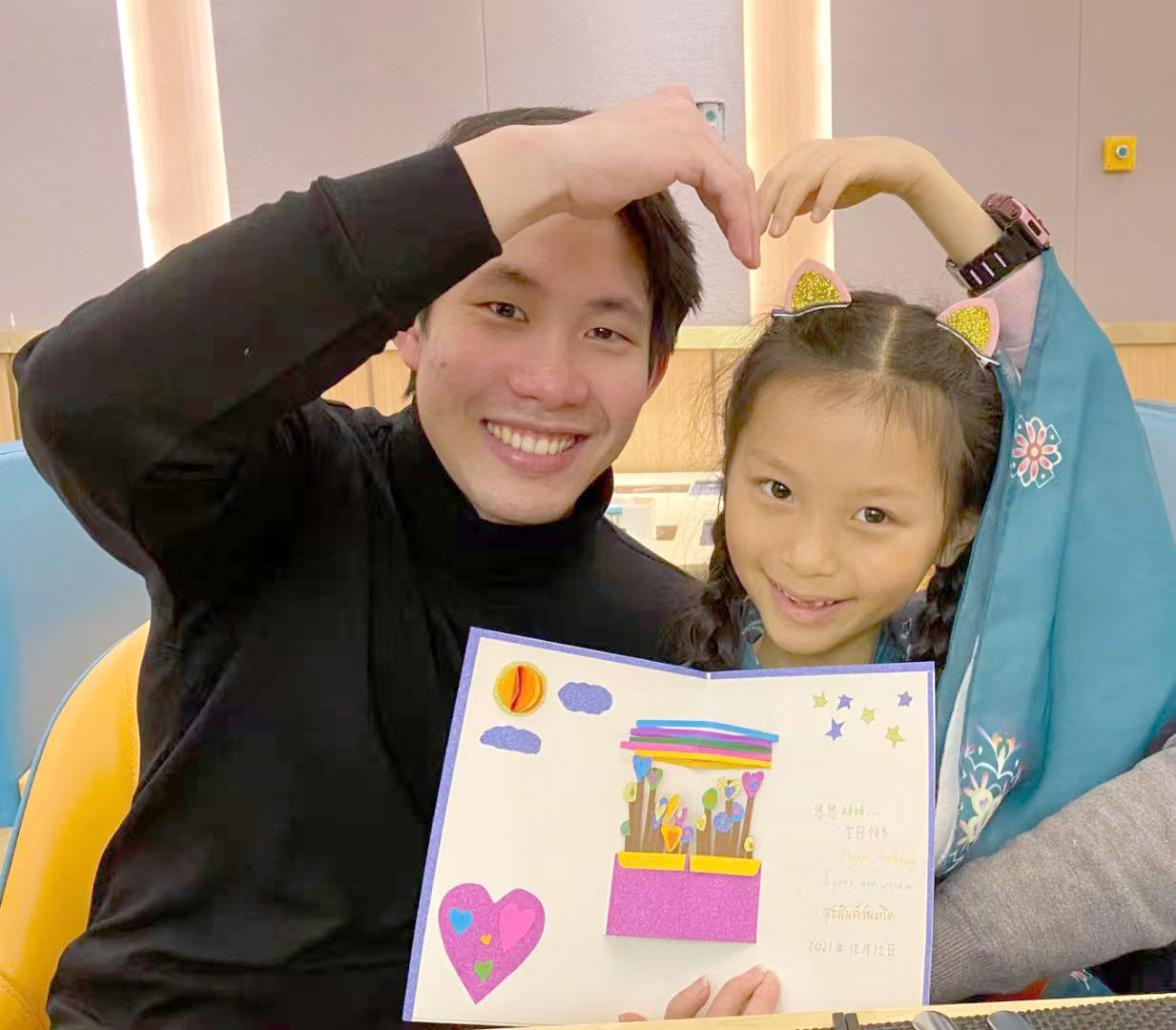
He also said the pandemic gave him an opportunity to develop a "family" in China. In 2020, Pitipat met 7-year-old Youyou and her grandmother at a flea market.
"The family is so nice and kind. They invited me home and we gradually became close friends. Youyou wrote Chinese words on cards with assistance from her grandmother and practiced spoken language with me almost every day," he said.
During his stay in Chongqing, the family invited him every year for dinner on Chinese New Year's Eve — the most important family gathering in Chinese tradition.
"The family is the epitome of hospitality and generosity," he said. "I call the grandmother ganma, a godmother or an adoptive mother in Chinese, which represents affectionate family ties."
Pitipat said he also made friends with a lot of Chinese people, which led him to appreciate the diversity of Chinese culture, the cutting-edge technologies, and to explore the wonders created by its people.
After completing his studies in China, Pitipat returned to Bangkok in 2022, where he works for a leading Chinese plastics company.
He said his goal is to serve as a bridge between Thailand and China with his experiences, contributing to his country's development with Chinese advanced technologies, and helping people from the two nations know each other better.
"Although many Thai people have Chinese blood, the younger generations in Thailand can hardly imagine how dramatically China has changed over the past decades," he said.
China is not just a country known through books or movies, but it's a great power, he said, referring to the high-speed rail networks and strides made in AI technology.
There are many Thai people who have never been to China and have misunderstandings about the country, he said.
Despite gaps in understanding, many Thai people, however, "believe that Asia, China in particular, will be the future of the world. And Thailand should take a ride on China's 'express' and seek a greater future" for Thai people, he said.
Contact the writers at yangwanli@chinadaily.com.cn
