

China’s growth expected to remain on a steady upward path this year, say analysts

China’s industrial sector posted solid year-on-year growth in 2025, the country’s top industry regulator said on Jan 21, reinforcing experts’ assessment that advanced manufacturing, artificial intelligence-enabled industries and emerging sectors have strengthened the economic resilience underpinning last year’s 5 percent GDP expansion.
“In 2025, the value added of major industrial enterprises grew 5.9 percent year-on-year, while the share of manufacturing value added in GDP remained stable, with the manufacturing sector expected to remain the largest globally for a 16th consecutive year,” said Zhang Yunming, vice-minister of industry and information technology.
Speaking at a news conference, Zhang said the industrial and information sectors accounted for more than 40 percent of economic growth.
Amid global economic uncertainties, China’s industrial and information sector has demonstrated notable resilience and vitality over the past year, with growth momentum continuing to build, delivering both qualitative improvements and sound quantitative expansion, Zhang said.
Zhu Keli, founding director of the China Institute of New Economy, said that China’s manufacturing sector delivered a strong overall performance in 2025, reflecting strengthening internal momentum and laying a firmer industrial foundation for high-quality economic development.
“Crucially, this expansion has not been driven by sheer scale. Instead, AI-enabled industries, emerging industries and advanced manufacturing have become the main engines of the economy, powering growth while reshaping the industrial structure,” he added.
Zhu noted that these sectors have continued to generate growth momentum, pushing equipment manufacturing and high-tech manufacturing to expand significantly faster than major industrial enterprises overall, providing strong support for economic growth.
In 2025, value added by major equipment manufacturing and high-tech manufacturing enterprises rose 9.2 percent and 9.4 percent year-on-year, respectively, exceeding the growth rate of major industrial enterprises by 3.3 and 3.5 percentage points, said the Ministry of Industry and Information Technology (MIIT).
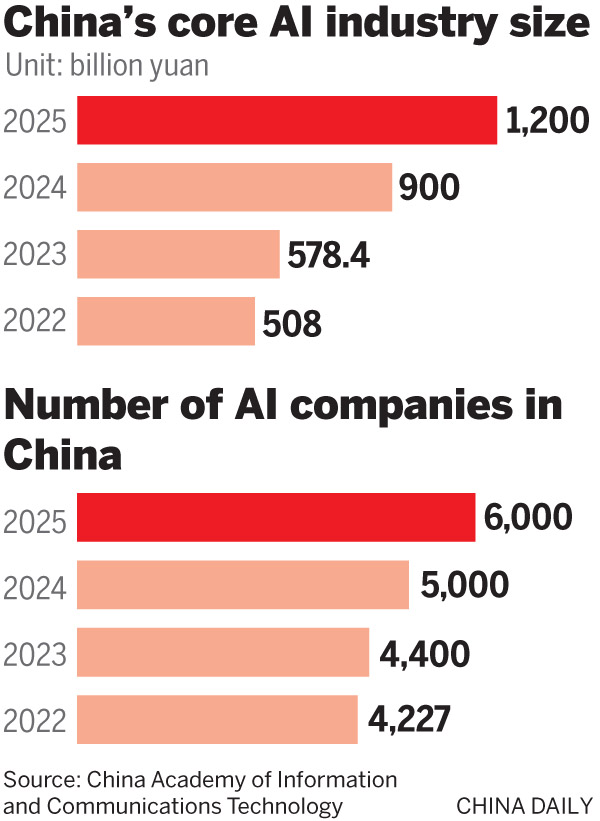
Notably, AI is emerging as a powerful engine of industrial growth said Zhang, the vice-minister.
“Industry estimates suggest that the number of AI enterprises in China surpassed 6,000 in 2025, with the core sector expected to exceed 1.2 trillion yuan ($172.4 billion) in size.”
He pointed to a series of concrete advances, including the rollout of a wave of AI chips and the emergence of homegrown foundation models as leaders in the global open-source ecosystem.
Meanwhile, the range of AI-powered products is expanding rapidly. Sandy Xu Ran, chief executive officer of Chinese e-commerce giant JD.com, said products with real AI capabilities —such as robots and smart glasses —are emerging as major new engines of consumption, with sales in the two categories tripling and rising tenfold year-on-year in 2025, respectively.
“Sales of robots were constrained by supply. Otherwise, growth would have been even stronger,” Xu said on Jan 21 at the World Economic Forum annual meeting in Davos, Switzerland.
To sustain the momentum, “we will step up State-backed investment and fast-track key technologies to accelerate the development of humanoid robots”, Vice-Minister Zhang said.
Samuel Li Xiangming, a professor at Northeastern University, said: “Humanoid robots could reshape global supply chains. While United States AI giants are still locked in fierce competition at the frontier, China should move quickly to refine the humanoid robot supply chain, make it more precise and efficient and build advantages that are hard to replace.”
The efforts also come as China presses ahead with next-generation 6G. Noting that “China has already kicked off the second phase of 6G technology trials”, Xie Cun, head of the information and communication development department at the MIIT, said, “Moderately advancing ahead of demand has been one of our key practices in building information infrastructure.”
Huang Yuhong, general manager of the China Mobile Research Institute, said, “With continued breakthroughs in core technologies such as the integration of 6G networks and AI, commercial 6G services are expected to start around 2030.”
Looking ahead, Zhang said he remains confident that the industrial economy will remain on a steady upward path in 2026.
Contact the writers at yinmingyue@chinadaily.com.cn
