

BEIJING - Chinese football endured an eventful 2025 as the men's national team crashed out of 2026 World Cup qualifying, but a steady stream of emerging talent offered a glimmer of light.
Despite the familiar disappointment, the passion of Chinese football fans remained undimmed - from the national team to the flourishing grassroots scene represented by the "Su Super League."
Qualifying heartbreak
China's men's national team regrouped in March for the final stretch of its World Cup qualifying campaign. After six matches in 2024, Branko Ivankovic's side sat bottom of Group C with two wins and four defeats, but was only one point behind second-placed Australia.
Buoyed by improved late-2024 form and newly naturalized player Sai Erjiniao, China entered the March window with confidence.
A series of underwhelming performances quickly crushed those hopes. Back-to-back defeats to Saudi Arabia and Australia left China on the brink. A narrow 1-0 loss away to Indonesia in June sealed its fate.
The campaign again exposed a significant technical gap with Asia's leading teams. Ivankovic faced heavy criticism for his tactics, particularly his insistence on a 4-4-2 diamond formation.
The year also left a bitter aftertaste for the women's team. An 8-0 defeat to European champion England served as a stark warning of the growing gap with the world's elite.
A new generation emerges
The qualifying failure led to Ivankovic's dismissal. While criticized for a lack of attacking spark, he did integrate several young players. Among them was Wang Yudong, who converted the winning penalty in China's eventual 1-0 victory over Bahrain.
Wang carried that momentum into the Chinese Super League season with Zhejiang FC. His pace, movement and composure earned increasing trust. The 19-year-old finished with 11 goals - a league best among domestic players - and was named Young Player of the Season.
He is far from the only emerging star. The 2025 CSL saw several young players break through. In late November, 17-year-old Wei Xiangxin signed for French Ligue 1 side AJ Auxerre, renowned for its youth academy.
The rise was reflected at the youth national level. China reached the quarterfinals of the AFC U20 Asian Cup in February, finishing one win away from the FIFA U20 World Cup. It also secured its place at next year's U17 Asian Cup in impressive fashion.
This shift points toward a structural rebuild focused on youth development. Some pundits argue this consolidation, rather than quick fixes, will foster growth based on patience and a clear identity.
The appointment of Shao Jiayi as the new men's national team head coach in November could accelerate the process. His tenure is expected to usher in a new era, with veterans fading and more space opening for youth.
Enduring fan passion
Despite the World Cup setbacks, enthusiasm for the game continued to grow.
According to the Chinese Professional Football League (CFL), an independent body that operates all levels of China's professional leagues, the CSL alone attracted 6,180,991 spectators last season, an average of 25,754 per game.
Dalian Yingbo led the league with an average home attendance of 58,268, while Beijing Guoan and Chengdu Rongcheng both averaged over 40,000. Seven other clubs, including Shanghai Shenhua, Shandong Taishan and Tianjin Jinmen Tigers, drew more than 20,000 spectators per game.
Across all competitions, total attendance in China's three professional tiers reached 8,957,759, an 18 percent increase compared with the 2024 season.
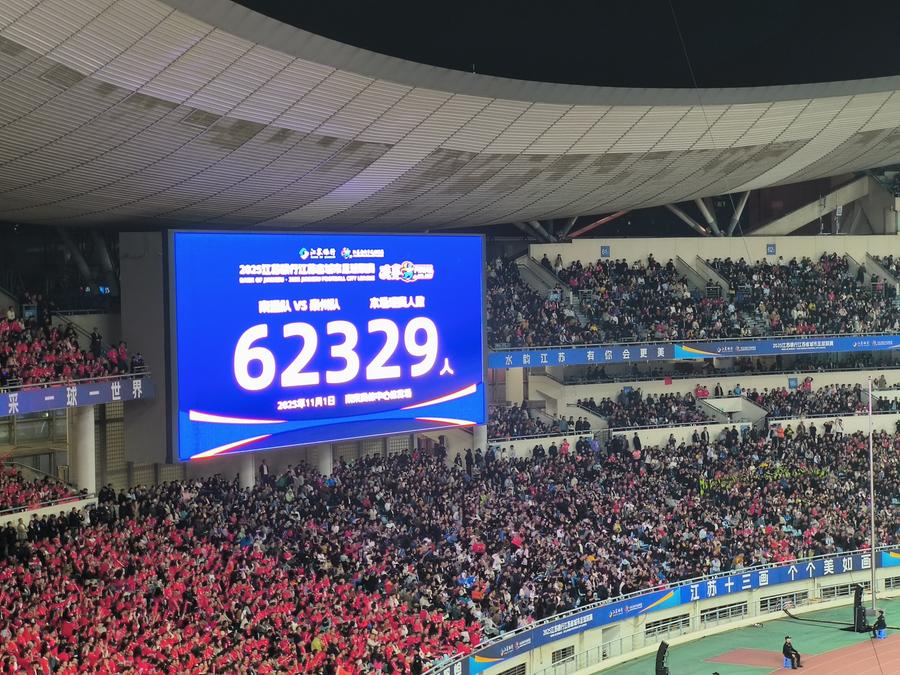
Yet these numbers were rivaled in the public imagination by the "Su Super League." What began as a regional competition grew into a full-blown social phenomenon.
The league's players are mostly teachers, students, office workers and mechanics. Its 85 matches drew a combined 2.43 million spectators, averaging 28,600 per game. Online livestreams amassed 2.22 billion views.
Riding that success, the grassroots wave has spread nationwide. Many regions have launched their own locally branded tournaments, turning mass football into a sensation.
