

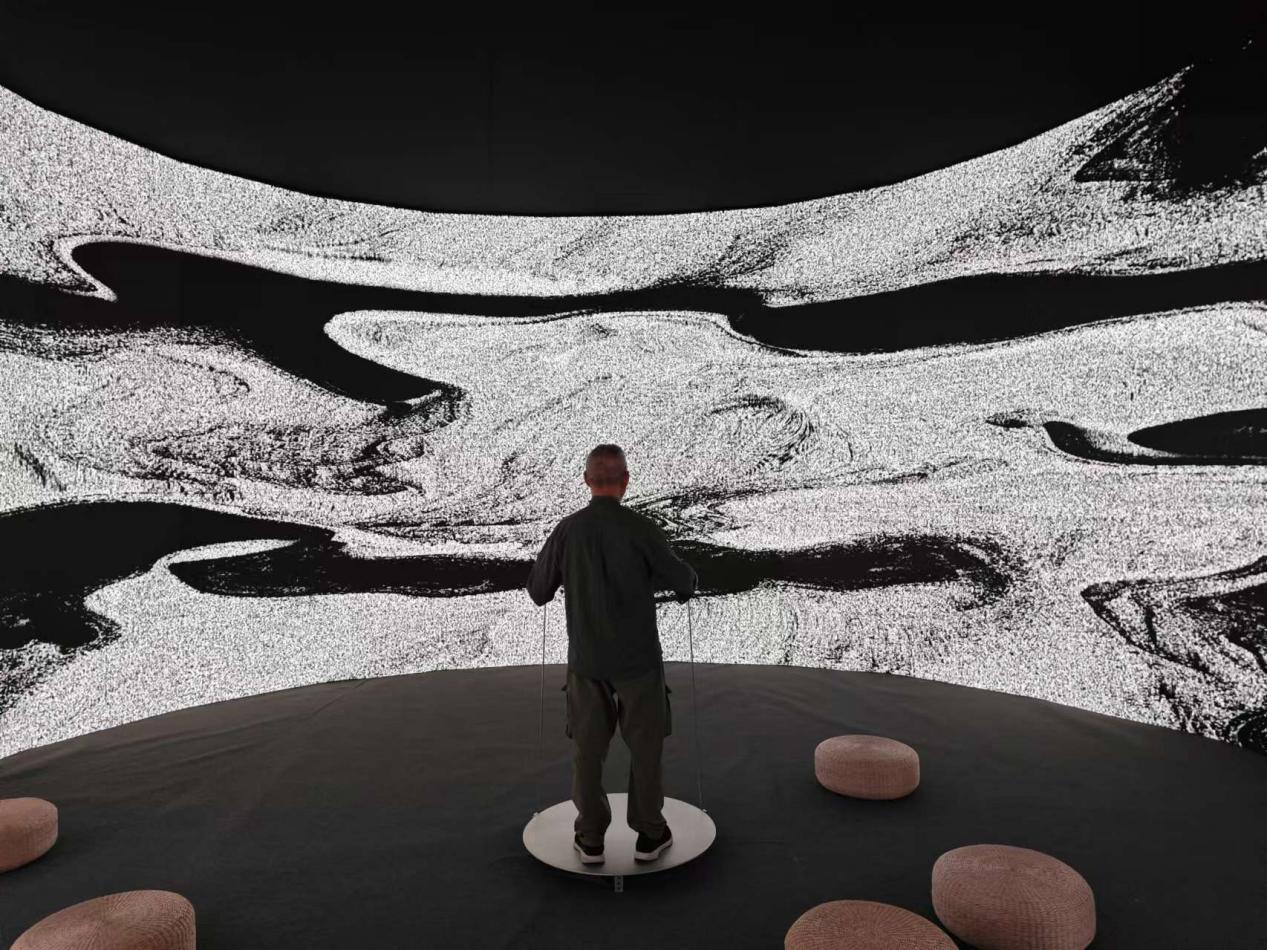
AI-generated ink wash paintings, robots practicing calligraphy, and robots playing the piano — these futuristic displays captivated audiences at an AI art exhibition on Friday, showcasing the potential of artificial intelligence in fields such as visual storytelling, creative expression, historical preservation, and imagining the future.
Organized by Bauhinia Culture Group, the inaugural Hong Kong AI Art Festival debuted at the Hong Kong Convention and Exhibition Centre. Highlighting the convergence of art and technology, the event brought together 30 artists and over 30 robotics companies from around the globe. Themed “Envisioning the Future: Reality and Boundlessness”, the festival seeks to bolster the Hong Kong Special Administrative Region’s role as a global innovation and technology hub, while fostering cultural exchange between China and the international community.
Technology has begun to assist in creating art, though it appears to remain largely at the stage of following instructions. One team presented a piece titled “The Dream of Robots”. Through one-on-one interactions with the audience, the sleeping robot can capture their external features and use a large language model to generate abstract particle images and descriptions — creating the impression that the viewer is appearing in the robot’s dream.
Liu Jiayu, one of the creators, stated that while AI can produce artworks within pre-defined contexts, it cannot perform such contextualization itself — and this is the most crucial aspect of the artistic creation process.
ALSO READ: When AI meets art
In March, an AI-generated animation created by digital artist Refik Anadol sold for $277,000 at auction, sparking widespread discussion. However, Turing Award winner John Edward Hopcroft said he believes that AI will not replace artists.
“If an artist draws a picture and AI does too, although its creations may look very similar and a person might not distinguish them, it will evoke a different feeling because it’s not the picture that’s important,” Hopcroft said.
However, AI can assist in many aspects of the artistic creation process, such as enhancing creative efficiency and reconstructing historical imagery. “AI has significantly increased my creative efficiency,” said Wang Xiaohui, an artist who presented her AI-designed video series featuring 100 futuristic career women at the festival.
Previously, she would manually piece together images using design software, but now AI enables her to directly generate dynamic visuals. “It once took me two years to create images of career women from the past 100 years, but with AI, I completed my work of the next 100 years in less than two months,” Wang said. She added that technological advancements compel artists to think about creating works that cannot be replaced by AI, thus driving the emergence of new artistic forms.
“AI can assist in cultural regeneration," said a Hangzhou-based team that created a VR film comprising stories from three historical periods related to grottoes. Through AI-powered restoration of image quality, viewers can use VR headsets to experience these historical tales. A creator surnamed Qian from the team stated, "We focus more on the narrative aspect of the film. AI is merely a tool to assist in creation — the core still lies in the artist's individual creativity.”
Contact the writer at akirawang@chinadaily.com
