

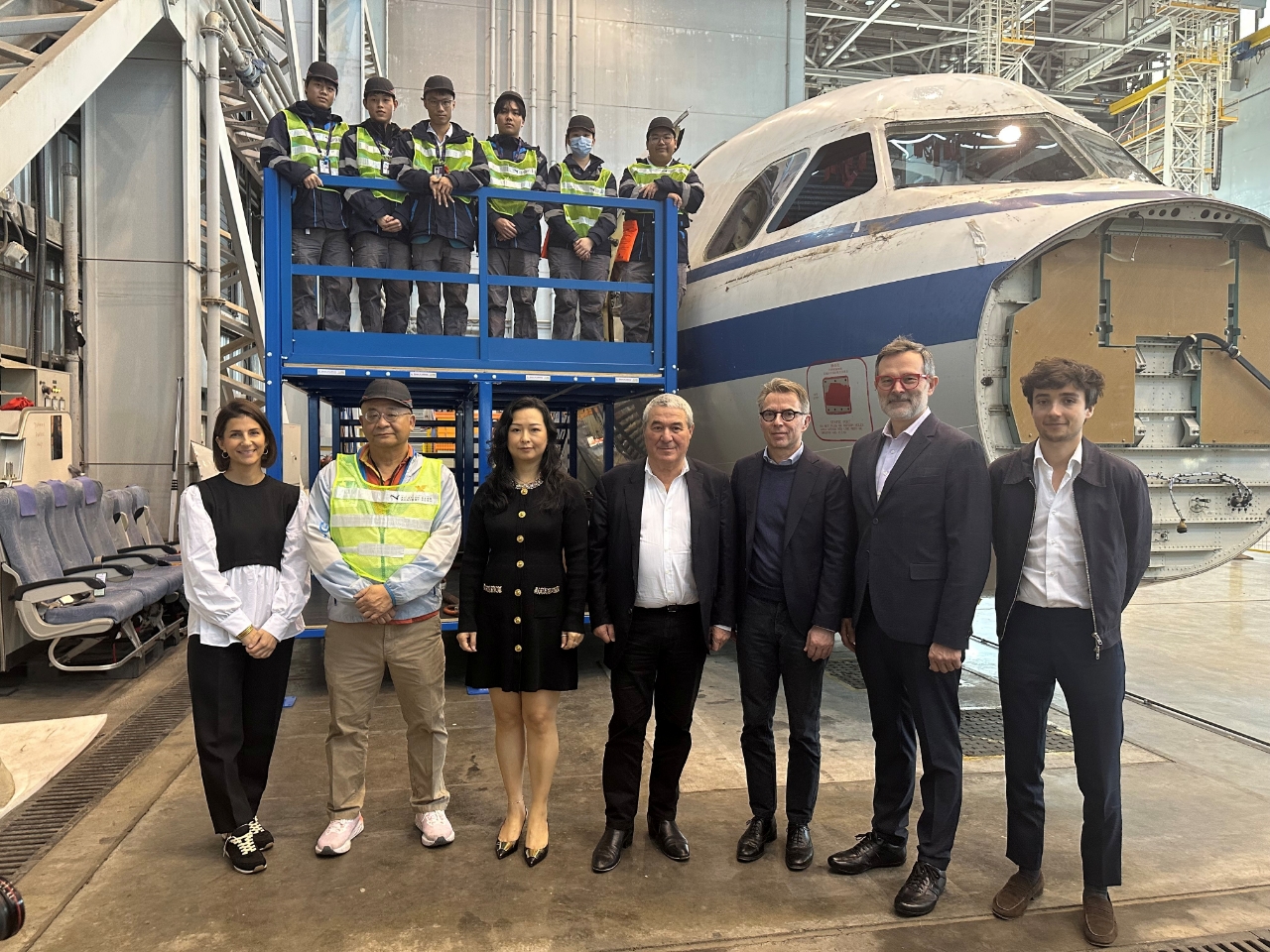
Elior Group SA, a French-based aeronautic services company, and the Hong Kong Special Administrative Region are joining forces to tap into the fast-growing, multibillion dollar global aircraft recycling market, with plans to develop the city into Asia’s next high-value aviation recycling hub with a complete parts trading chain.
Earlier this month, Elior, in partnership with the Hong Kong International Aviation Academy, started a one-month trial of a mechanic training program on dismantling aircraft, marking the first step in its local expansion, as outlined in a memorandum of understanding signed in March.
Elior Asia CEO Janet Cheung said the program is designed to equip mechanics with hands-on, practical experience rather than relying solely on textbooks or video demonstrations.
ALSO READ: Cathay chair urges continued LegCo support to bolster global aviation hub status
To support the training, a high-fidelity mock-up of a retired aircraft cabin section has been shipped from Southwest China’s Sichuan province, allowing trainees to practice installing and dismantling seats, overhead compartments, and other aircraft parts in an authentic environment.
Specialists from Elior’s mechanical engineering team in France, which has decades of experience serving Airbus and Boeing, have been sent to Hong Kong to provide on-site supervision and guidance.
Currently, more than 10 locally recruited mechanics are participating in the trial class. Eventually, the training program will expand to include trainees from the Chinese mainland and Southeast Asia, and the duration of classes will be adjusted according to the actual situation, Cheung said.
The training program demonstrates Elior’s commitment to talent development and forms a key part of its road map to establish an aircraft recycling industry in Hong Kong, where the sector had little prior presence.
Meeting a growing need
Elior consultant Lionel Roques said that while aircraft are designed to operate for over 30 years, owners often choose to retire planes after around 20 years to make way for new models, reduce insurance costs, or comply with policy restrictions.
Roques said many components from retired planes still hold significant value. For example, parts from a narrow-body plane 18 to 20 years old can be worth up to $15 million, while a retired engine may fetch $5 million to $6 million, depending on its remaining usable cycles.
According to the European Union Aviation Safety Agency, an average of 650 commercial aircraft were retired annually over the past decade. Ireland-based analyst firm Research and Markets said the global aircraft recycling market is projected to grow from $6.8 billion in 2025 to over $13.8 billion in 2034.
In Asia, while some aircraft dismantling centers have been established on the mainland and in South Korea, most primarily serve domestic demand, leaving much of the regional market demand unmet, Roques said.
Against this backdrop, the company sees Hong Kong as well-positioned to serve as a regional hub, given its strong airfreight capacity, zero-tariff policy, and the compatibility of different aircraft maintenance standards.
Beyond training, Elior plans to establish a disassembly operation center at Hong Kong International Airport, alongside a recycling plant elsewhere in the city.
“Elior hopes to develop the entire industrial chain centered around aeronautic services (in Hong Kong). This includes aircraft disassembly, parts trading, and material recycling,” Cheung said.
READ MORE: Deal to enhance HK-Zhuhai aviation cooperation
In Hong Kong Chief Executive John Lee Ka-chiu’s 2025 Policy Address, Hong Kong, for the first time, listed aircraft recycling among its industry development strategies. Lee said Elior’s expertise in airplane parts recycling and trading could stimulate growth across related industries, including trading, insurance, financing and leasing, and create new job opportunities, further consolidating Hong Kong’s status as an international aviation hub.
Cheung said Elior is finalizing administrative procedures with the SAR government and airport authorities, with the goal of determining the location of the recycling plant by mid-2026.
She said Elior also hopes the government will further support the growth of the emerging industry through favorable policies and tax incentives.
