

At Chengdu meeting, leaders underline China-France understanding, lessons from history
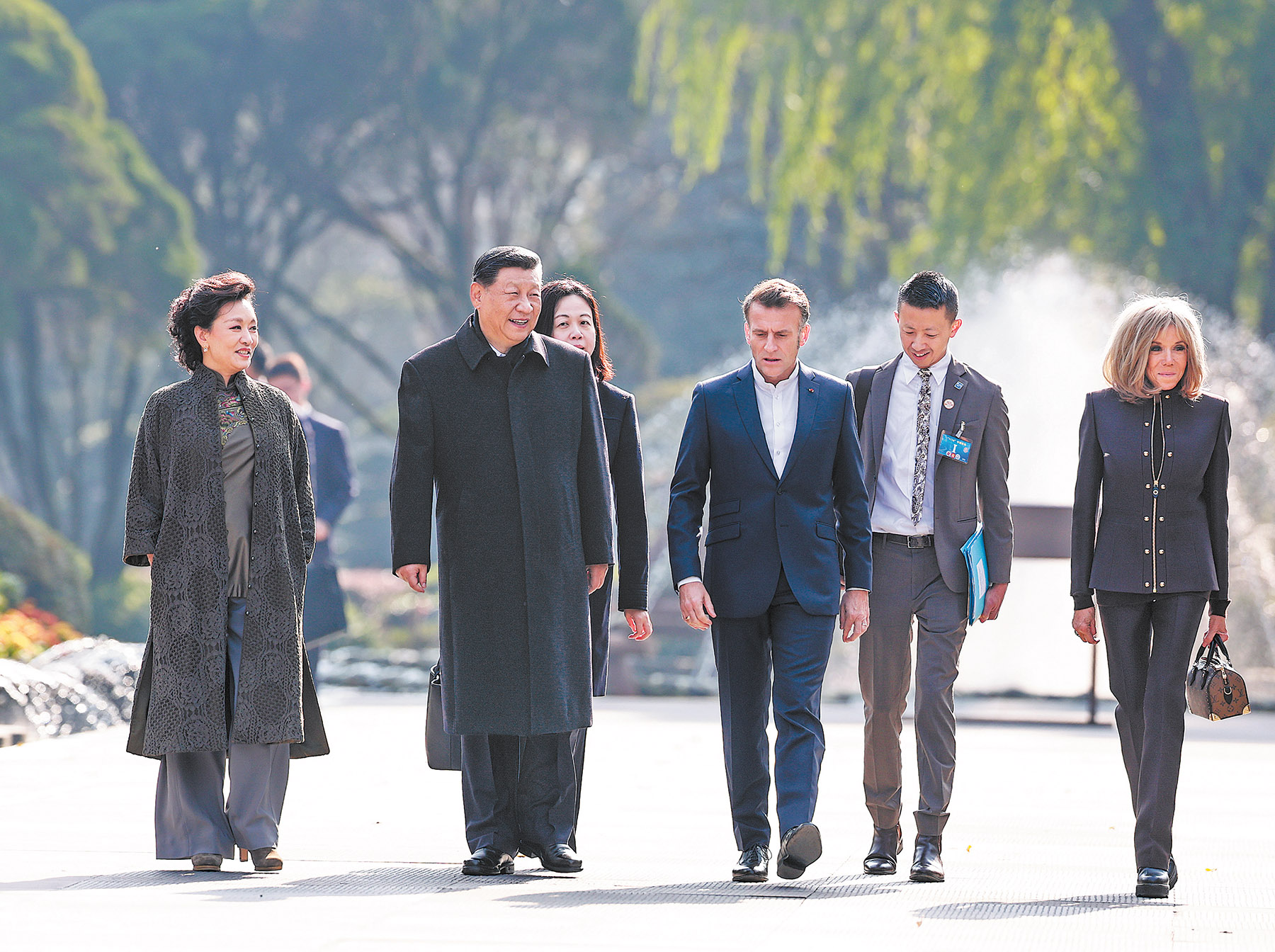
President Xi Jinping said on Dec 5 that China and France, as two major nations distinguished by their histories and cultures, can make greater contributions to global peace, stability, and human progress through dialogue and cooperation, in a world facing intertwined changes and turmoil.
Xi made the remarks during friendly exchanges with visiting French President Emmanuel Macron in Dujiangyan, in Chengdu, capital of Southwest China’s Sichuan province. Dujiangyan is a 2,000-year-old pioneering irrigation system that achieved automatic water regulation and flood control without the use of dams or gates.
The meeting marked the second encounter between the two leaders during Macron’s three-day visit to China, following their talks in Beijing on Dec 4.
Xi told Macron that the Dujiangyan irrigation system, as the world’s only ancient irrigation project still in operation, stands as one of the earliest successful practices of harmonious coexistence between humanity and nature.
Its construction process, he said, fully reflects the Chinese nation’s spirit of constant self-improvement, fearlessness in the face of hardship, and courage to forge ahead.
Each visit to Dujiangyan, Xi said, offers a reminder of the wisdom of the ancients, that is, adapting to local conditions, embracing the trend of the times, achieving harmony between humanity and nature, and managing water for the benefit of the people.
“This spirit still offers insights for state governance today,” he said.
Macron, who praised the diligence and wisdom of the Chinese people, said that China and France both possess ancient civilizations, and their peoples share the same aspiration for a better life.
Bilateral cooperation, he added, can advance development and prosperity and bring tangible benefits to both peoples.
Xi and his wife Peng Liyuan also enjoyed tea by the waterside with Macron and his wife, Brigitte Macron.
The establishment of diplomatic relations between the two countries was not only a “handshake” between two independent countries, but also the convergence of two splendid civilizations, Xi added.
Macron said that given the rapidly evolving international landscape that is rife with uncertainties, France is willing to strengthen communication and coordination with China, engage in dialogue and consultation to address conflicts, and work together to safeguard world peace and stability.
The two heads of state agreed to maintain close communication to jointly promote the continuous development of the China-France comprehensive strategic partnership.
The Dec 5 exchange in Chengdu was the third time that Xi had an additional meeting with Macron outside the capital during Macron’s state visits to China.
In recent years, aside from their official talks, the two heads of state have repeatedly opted for meetings held in diverse and symbolically meaningful locations beyond their capitals.
Jin Ling, director of the Department for Global Governance and International Organizations at the China Institute of International Studies, said that meetings outside the capital help create space for a broader and more multidimensional relationship.
“Exchanges in Beijing and Paris tend to focus on political and economic issues,” she said. “But going outwards expands the breadth of the relationship, particularly in people-to-people and cultural engagement.”
Such visits also give leaders more time for strategic communication, which is essential for building political mutual trust, she said.
On each of his four state visits to China, Macron has made a point of traveling to another city beyond the capital, a practice that, Jin said, has helped the French president gain a better understanding of the country.
In a speech at Sichuan University on Dec 5, the final day of his trip, Macron said he firmly believes that China and France are both great and brilliant civilizations, and that mutual respect and understanding form the foundation of their friendship.
During Macron’s visit, China and France issued joint statements on strengthening global governance, joint response to global climate and environmental challenges, continuous promotion of cooperation in peaceful use of nuclear energy, exchanges and cooperation in agriculture and food, and the situations in Ukraine and Palestine.
On Dec 4, Xi said that China and France should always demonstrate the strategic vision and independence of a major country, offer each other understanding and support on issues concerning core interests and major concerns, and safeguard the political foundation of bilateral ties. That day Xi met Macron at the Great Hall of the People in Beijing.
Macron arrived in Beijing Dec 3 for his fourth state visit to China since taking office in 2017, bringing with him a delegation of over 80 members — among them several ministers and over 30 CEOs of major French companies.
The two leaders jointly witnessed the signing of multiple cooperation agreements in sectors including nuclear energy, agri-food, education, and the ecological environment.
Premier Li Qiang and Chairman of the Standing Committee of the National People’s Congress Zhao Leji also met separately with Macron on Dec 4.
